
We are reader supported. When you purchase through links on our site, we may earn an affiliate commission. Also, as an Amazon affiliate, we earn from qualifying purchases.
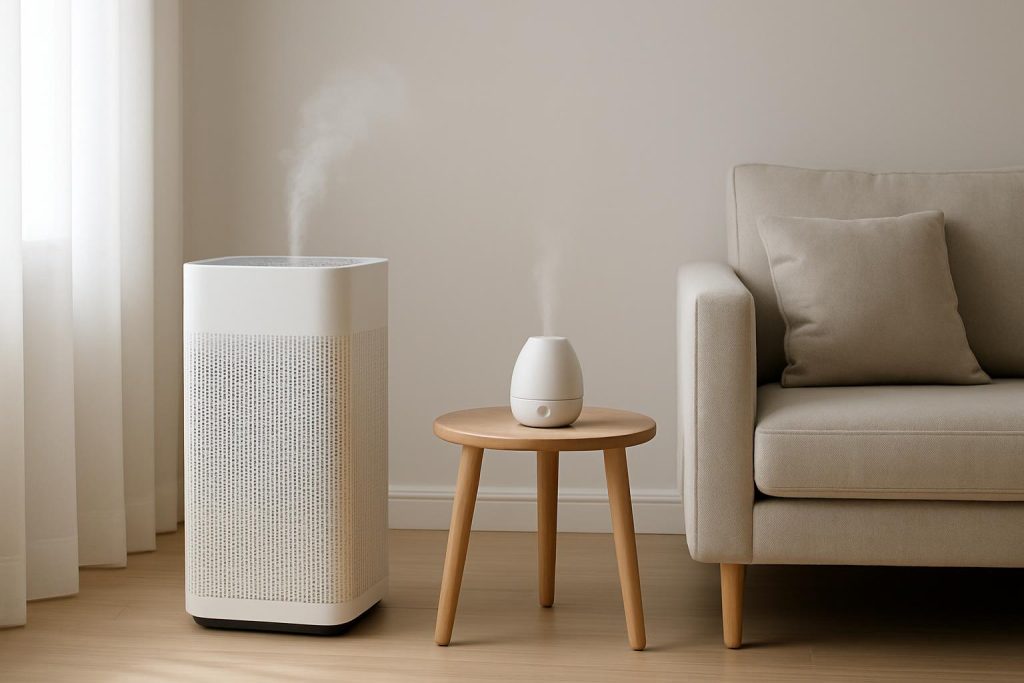
Yes, you can use an air purifier and a diffuser at the same time, but I wouldn’t place them right next to each other or expect them to work nicely together without a little planning.
I learned this the slightly annoying way. I had a HEPA air purifier running in our living room and an ultrasonic essential oil diffuser on the side table. Within minutes, the purifier’s air quality light changed color and the fan ramped up. At first, I thought something was wrong with the purifier. After some reading and a few tests around the house, I realized the purifier was reacting to the tiny particles and scent compounds coming from the diffuser.
So the quick, practical answer is this: you can run both, but the air purifier may remove some of the fragrance from the air, and some diffusers can make the purifier work harder. If your goal is cleaner air, keep the purifier running. If your goal is a room that smells strongly of essential oils, the purifier may reduce that scent faster than you expect.
Can you run an air purifier and diffuser in the same room?
Yes, you can run an air purifier and diffuser in the same room as long as you use them correctly. They are not dangerous together by default, but they do work against each other in some ways.
An air purifier is designed to remove particles, odors, smoke, dust, pollen, pet dander, and sometimes volatile organic compounds from the air. A diffuser adds scented droplets or vapor into the air, depending on the type of diffuser.
That means one device is trying to clean the air while the other is adding something to it.
In my home, the purifier did not “break” because of the diffuser. It simply detected extra airborne particles and increased its fan speed. That is normal behavior, especially with ultrasonic diffusers, which can release a mist made of water, minerals, and essential oil droplets.
The main things to watch are:
- How close the diffuser is to the purifier
- What type of diffuser you use
- Whether anyone in the home has asthma, allergies, migraines, or scent sensitivity
- Whether you have pets, especially cats or birds
- How often you diffuse oils and for how long
- Whether your purifier has a HEPA filter, carbon filter, or ionizer/ozone feature
For most homes, occasional diffuser use in the same room as a standard HEPA air purifier is fine. I would be more cautious with heavy essential oil use, small rooms, young children, pets, or anyone with breathing issues.
Why does my air purifier react when I turn on a diffuser?
If your air purifier suddenly speeds up after you start a diffuser, it is usually responding to particles or gases in the air.
Many newer purifiers have sensors that detect fine particles. Ultrasonic diffusers, in particular, can release microscopic droplets. Those droplets may look harmless as a visible mist, but to the purifier’s sensor, they can register similarly to other airborne particles.
This does not mean your diffuser is creating smoke or pollution in the same way a candle or wildfire does. But it does mean the purifier sees more “stuff” floating in the air.
Here is what may be happening:
- Ultrasonic diffusers create a cool mist that can carry water minerals and oil droplets.
- Nebulizing diffusers release pure essential oil particles without water, often in a more concentrated form.
- Reed diffusers release fragrance slowly through evaporation.
- Heat diffusers evaporate scent compounds and may alter the oil with heat.
If your purifier has an auto mode, it may increase fan speed because the sensor detects particles from the mist. If it has an activated carbon filter, it may also reduce the smell by adsorbing some odor compounds.
This is one reason people think their diffuser “isn’t working” after buying a purifier. The scent is being diluted, captured, or circulated differently.
Where should you place an air purifier and diffuser?
The biggest mistake I made was putting the diffuser too close to the purifier. The purifier pulled the mist straight into the intake, which wasted the oil and probably shortened the life of the filter.
A better setup is to separate them across the room, or at least keep several feet between them.
Here is a simple placement guide:
| Setup | Best For | What to Watch |
|---|---|---|
| Purifier on one side of the room, diffuser on the other | Balanced use of both devices | Scent may still fade faster than expected |
| Diffuser at least 6–10 feet from purifier intake | Reducing filter exposure to mist | Small rooms may still circulate mist quickly |
| Diffuser used first, purifier run later | Enjoying scent for a short period | Air is not being actively cleaned during that time |
| Purifier running continuously, diffuser used briefly | Homes with allergies, pets, or dust | Fragrance may be lighter |
| Diffuser next to purifier | Not recommended | Wastes oil and may load the filter faster |
I now keep our air purifier near the open part of the room, away from walls and furniture, and place the diffuser on a separate table. I also avoid aiming the diffuser mist toward the purifier intake.
A few practical placement rules:
- Do not put the diffuser directly in front of the purifier.
- Do not place either device on the floor if kids or pets can knock it over.
- Keep mist away from wood furniture, electronics, books, and fabric lampshades.
- Give the purifier breathing room around the intake and outlet vents.
- Use a tray under the diffuser if it tends to leave moisture behind.
Will a diffuser damage an air purifier?
Occasional diffuser use usually will not damage a good air purifier. The bigger concern is filter buildup over time.
Essential oils are not just “nice smells.” They are concentrated plant compounds. If those compounds are pulled into a purifier repeatedly, they can cling to filters, especially carbon filters and pre-filters. Mist from an ultrasonic diffuser can also carry minerals from tap water, which may leave white dust in the room and on the purifier’s intake.
That does not mean one evening of diffusing lavender oil ruins your machine. But daily, heavy diffuser use right next to a purifier can make filters dirtier faster.
Signs your purifier may be getting loaded from diffuser use include:
- The filter smells strongly like essential oils
- The purifier runs louder or harder than usual
- The filter looks oily, dusty, or discolored early
- The air quality sensor spikes every time you diffuse
- The purifier gives a filter change alert sooner than expected
One common mistake is assuming essential oils are harmless because they are natural. Natural does not automatically mean gentle on filters, lungs, pets, or indoor air quality.
If you diffuse often, check your purifier’s pre-filter more frequently. Some pre-filters can be vacuumed or rinsed, depending on the manufacturer’s instructions. HEPA filters usually should not be washed unless the manual specifically says they are washable.
Will an air purifier remove essential oil smell?
Yes, an air purifier can reduce essential oil smell, especially if it has an activated carbon filter.
A HEPA filter captures particles, but it does not do much for gases and odors by itself. Activated carbon is the part that helps trap many odor molecules and certain volatile organic compounds. Some purifiers have a thin carbon sheet; others have a heavier carbon bed. The heavier carbon filters tend to do a better job with odors.
In real life, this means your room may smell less fragrant if the purifier is running. I noticed this most with citrus and eucalyptus oils. The scent was still there, but it faded more quickly than it did before we had the purifier.
If you want the scent to linger longer, you can:
- Run the diffuser for 15–30 minutes, then turn it off.
- Use the purifier on a lower fan setting during diffuser use.
- Place the diffuser farther away from the purifier.
- Close the room door briefly if the space is safe and ventilated enough.
- Use fewer drops of oil but diffuse closer to where you are sitting, not near the purifier.
I do not recommend turning off the purifier for long periods if you rely on it for allergies, smoke, pet dander, or asthma triggers. Clean air matters more than a stronger scent.
Is it safe to breathe essential oils with an air purifier running?
For many healthy adults, short and moderate diffuser use is generally tolerated. Still, essential oils can bother some people, even in small amounts.
I became more careful after a family member complained that peppermint oil made their throat feel tight. That was a good reminder that “pleasant” to one person can be irritating to another.
Be cautious with diffusers if anyone in the home has:
- Asthma
- COPD or other lung conditions
- Migraine sensitivity
- Allergies or fragrance sensitivity
- Pregnancy-related smell sensitivity
- Infants or young children in the room
- Pets, especially cats, dogs, birds, rabbits, or small animals
Birds are especially sensitive to airborne chemicals and scents. Cats also have trouble processing certain essential oil compounds. Some oils that people commonly use, such as tea tree, eucalyptus, peppermint, cinnamon, citrus, clove, and wintergreen, can be risky around pets depending on the animal and exposure level.
If you have pets, ask your veterinarian before diffusing essential oils. At minimum, never trap an animal in a closed room with a diffuser. Give them a way to leave.
An air purifier may reduce some airborne oil particles, but it should not be treated as a safety shield. It does not make all oils safe for every person or pet.
Should you use a diffuser if you have allergies or asthma?
I would be careful. An air purifier is often helpful for allergies because it can reduce airborne dust, pollen, mold spores, and pet dander. A diffuser, on the other hand, adds fragrance compounds that may irritate sensitive airways.
Some people feel that certain scents help them relax or feel less congested. That feeling is real for them, but it is not the same as treating allergies or asthma. Essential oils do not replace medication, ventilation, humidity control, or allergen reduction.
If you have allergies or asthma and still want to use a diffuser, try a cautious approach:
- Use the diffuser for a short time, such as 10–15 minutes.
- Start with one drop of oil, not five or ten.
- Keep the door open the first time so the scent does not build up.
- Stop immediately if you cough, wheeze, feel chest tightness, or get a headache.
- Keep the air purifier running with a clean HEPA filter.
- Avoid strong oils such as peppermint, cinnamon, clove, and eucalyptus if they bother your breathing.
If your purifier’s sensor spikes every time you use the diffuser, that is useful information. It shows the diffuser is adding measurable airborne material. That may not be a problem for everyone, but for sensitive lungs, it is worth taking seriously.
What type of diffuser works best with an air purifier?
If you want the least conflict between the two devices, a passive or low-output diffuser is usually easier to manage than a strong misting diffuser.
Here is a practical comparison:
| Diffuser Type | How It Works | How It Pairs With an Air Purifier | My Take |
|---|---|---|---|
| Ultrasonic diffuser | Uses vibration to create cool mist | May trigger particle sensors and add moisture | Fine for short use, but keep it away from purifier intake |
| Nebulizing diffuser | Disperses pure essential oil without water | Can release a stronger concentration of oil into the air | Use sparingly, especially around pets or sensitive people |
| Reed diffuser | Evaporates fragrance through reeds | Less likely to trigger particle sensors | Better for gentle scent, though still not ideal for sensitive households |
| Heat diffuser | Uses warmth to evaporate oils | May change the scent profile and release fragrance compounds | Not my first choice; easy to overdo scent |
| Passive ceramic or stone diffuser | Oil evaporates naturally from a surface | Very low output | Good for a desk or small area, not whole-room scent |
For my home, a small ultrasonic diffuser used briefly works fine, but I no longer run it for hours. If someone is visiting who is sensitive to fragrance, I skip it completely and just run the purifier.
Can you put essential oils in an air purifier?
No, not unless the air purifier is specifically designed for essential oils.
This is one of the most common mistakes I see. People add a few drops of oil onto the filter or into the air outlet because they want the purifier to spread fragrance. That can damage the filter, interfere with airflow, create residue inside the machine, and possibly void the warranty.
Most air purifiers are not built to diffuse oil. Their job is to clean air, not scent it.
Some devices include a small aroma pad or scent compartment. If yours has that feature, follow the manual closely. Use only the amount recommended. Do not drip oil directly onto HEPA filters, carbon filters, fan blades, sensors, or vents.
Also avoid adding essential oils to a humidifier unless the humidifier is made for oils. Many humidifier tanks and internal parts can be damaged by oils.
What is the best way to use both without wasting oil or filters?
The best routine I have found is simple: clean the air most of the time, diffuse lightly and occasionally.
Here is the routine that works well in our house:
- Keep the purifier running regularly to manage dust, pollen, pet dander, and everyday indoor particles.
- Use the diffuser for short sessions, usually 15–30 minutes.
- Place the diffuser across the room from the purifier, not beside it.
- Use distilled or filtered water in an ultrasonic diffuser to reduce mineral dust.
- Use fewer oil drops than the diffuser manual suggests if the scent is strong.
- Clean the diffuser often so old oil residue and water film do not build up.
- Check the purifier filter more often if you diffuse frequently.
If I want the room to smell nice before guests arrive, I run the diffuser briefly before they come over, then turn it off and leave the purifier on low. That gives a light scent without turning the room into a perfume cloud.
If the air outside is smoky, pollen is high, or someone in the house is sick, I skip the diffuser. In those moments, the purifier has the more important job.
Are air purifiers with ionizers safe to use with diffusers?
I avoid ionizers and ozone-producing air cleaners, especially with fragrance products in the home.
A standard mechanical HEPA air purifier is different from an ozone generator. HEPA filtration physically captures particles. Activated carbon adsorbs some odors and gases. Ozone generators intentionally produce ozone, which can irritate the lungs. Some ionizers can also produce small amounts of ozone.
Ozone can react with certain fragrance compounds and create byproducts that may irritate indoor airways. For that reason, I prefer a purifier with:
- True HEPA filtration
- A separate activated carbon filter
- No ozone generation
- An ionizer that can be turned off, if included
- Appropriate CADR for the room size
If your purifier has an “ion,” “plasma,” “UV,” or “fresh air” mode, read the manual and look for ozone information. If you are unsure, leave that feature off and use the regular fan/filter mode.
Common mistakes to avoid
After experimenting at home and reading more than I expected to about indoor air, these are the mistakes I would avoid:
- Putting the diffuser beside the purifier. This sends mist directly into the filter and weakens the scent quickly.
- Using too much oil. More drops do not always mean better. Often it just means headaches and irritated throats.
- Running the diffuser all day. Short sessions are usually enough.
- Ignoring pets. Oils that smell harmless to us may not be safe for animals.
- Using tap water in an ultrasonic diffuser. Hard water can create white dust that settles on surfaces and may get pulled into the purifier.
- Adding oil to the purifier filter. Unless the device is designed for it, do not do this.
- Assuming the purifier makes diffusing risk-free. It can reduce particles and odors, but it does not cancel every possible irritant.
FAQ: Using an air purifier and diffuser together
Should I turn off my air purifier while using a diffuser?
You do not have to turn it off. If your main concern is allergies, smoke, dust, or pet dander, keep the purifier running. If you want to enjoy the scent more, you can run the diffuser briefly with the purifier on a lower setting, then return the purifier to normal afterward.
How far should a diffuser be from an air purifier?
Aim for at least 6 to 10 feet if the room allows it. More distance is better. The main goal is to keep the diffuser mist from being pulled directly into the purifier intake.
Can a diffuser make indoor air quality worse?
It can add particles and fragrance compounds to the air, especially if used heavily or in a small closed room. That does not mean every diffuser session is harmful, but it does mean diffusers are not air-cleaning devices. People with asthma, allergies, migraines, pets, or young children should be more cautious.
Why does my air purifier show bad air quality after I use essential oils?
The purifier’s sensor may be detecting fine mist droplets or airborne particles from the diffuser. Ultrasonic diffusers are especially likely to cause this. The reading does not always mean the air is dangerous, but it shows the purifier is sensing added airborne material.
Can I use a diffuser instead of an air purifier?
No. A diffuser does not remove dust, pollen, smoke, mold spores, or pet dander from the air. It only adds scent or mist. If you need cleaner air, use a proper air purifier with a HEPA filter and, ideally, activated carbon for odors.
Can I use essential oils around pets if I have an air purifier?
Be careful. An air purifier does not guarantee pet safety. Some essential oils can be risky for cats, dogs, birds, and small animals. Ask your veterinarian before diffusing oils around pets, and always let pets leave the room.
Will a HEPA filter remove essential oils?
A HEPA filter can capture some oil droplets or particles, but it is not designed to remove odors or gases. Activated carbon is more useful for reducing smells and certain vapor compounds.
Is it better to use a candle, diffuser, or air purifier?
For cleaner air, use an air purifier. For scent, a diffuser is usually cleaner than a scented candle because it does not produce soot from combustion. Still, diffusers add fragrance compounds to the air, so moderate use is best. Candles, incense, and wax melts can add more particles and odors for the purifier to handle.
My practical recommendation
If you came here because your purifier started acting strange after you turned on a diffuser, your purifier is probably doing exactly what it was built to do. It is sensing and filtering what the diffuser added to the air.
You can use both in the same home and even in the same room. Just give them space, diffuse lightly, and pay attention to how people and pets react.
For everyday use, I would choose clean air first and fragrance second. Run the purifier as your main indoor air tool. Use the diffuser occasionally, away from the purifier, for short periods. That approach gives you the comfort of a nice scent without fighting your purifier, wasting essential oil, or loading your filters faster than necessary.