
We are reader supported. When you purchase through links on our site, we may earn an affiliate commission. Also, as an Amazon affiliate, we earn from qualifying purchases.
The short answer: you can put a humidifier in a carpeted room, but you should not place it directly on carpet unless the manufacturer specifically says it is safe and the unit is sitting on a stable, waterproof surface.
I learned this the annoying way one winter after setting a small cool-mist humidifier next to my bed on a thick bedroom carpet. It worked for my dry throat, but after a few nights I noticed the carpet felt slightly damp around the base. Not soaked, just “something isn’t right” damp. That was enough to send me down the rabbit hole of humidifier placement, carpet moisture, mold risk, and whether I had just made my bedroom healthier or worse.
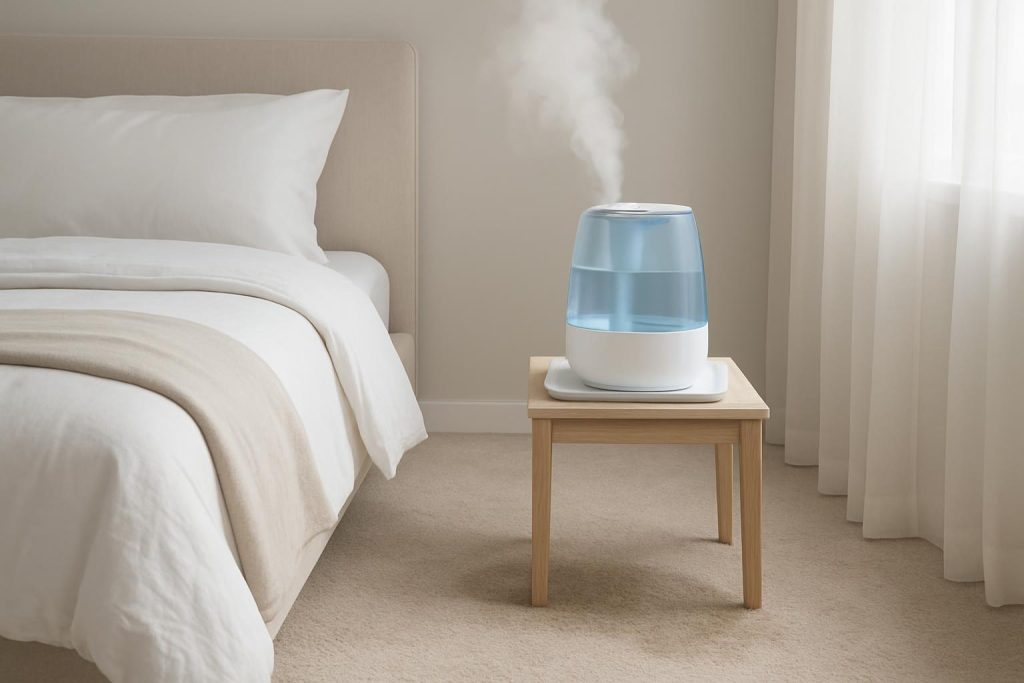
My practical answer now is this: use the humidifier in the room if you need it, but put it on a hard, level, raised, waterproof surface. A small table, nightstand, plant stand, plastic utility tray, or sturdy platform is much safer than carpet. Keep the mist aimed away from walls, bedding, curtains, electronics, and upholstered furniture.
Can you put a humidifier directly on carpet?
You technically can place some humidifiers on carpet, but it is usually a bad idea. Carpet is soft, absorbent, and uneven. That creates three main problems: stability, trapped moisture, and poor airflow around the unit.
Many humidifiers release moisture downward or sideways before it fully disperses into the room. On carpet, that moisture can settle into the fibers and padding. The top may feel dry while the padding underneath stays damp. That hidden dampness is exactly the kind of thing that can lead to musty smells, mildew, or mold.
Carpet also makes a humidifier easier to tip over. Even if the tank never spills, a slight tilt can interfere with how the float valve, wick, or mist outlet works. I have had one ultrasonic unit leave a wet patch simply because it was sitting at a slight angle and mist was hitting the floor instead of drifting into the room.
If the humidifier is a warm-mist model, direct carpet placement is even less appealing. Warm-mist humidifiers heat water, and while most modern models have safety features, placing a heated appliance on a soft surface is not something I would do in my home.
What are the pros of using a humidifier in a carpeted room?
A carpeted room is often a bedroom, nursery, or living room, which are exactly the rooms where people notice dry air the most. So the humidifier itself is not the problem. The placement is the problem.
Used correctly, a humidifier in a carpeted room can help with:
Dry throat and nasal irritation: In winter, forced-air heat can make a bedroom painfully dry.
Static electricity: Dry carpet can hold static. Raising indoor humidity can reduce those little shocks.
Dry skin and cracked lips: Many people sleep better when the air is not overly dry.
Wood furniture and floors nearby: Very dry air can shrink or crack wood, though too much humidity creates its own problems.
Comfort during colds: Moist air can feel soothing when your nose and throat are irritated.
The big benefit is comfort. In my house, keeping the bedroom around 40% humidity during the driest months made a noticeable difference. I woke up less stuffy, the room felt warmer, and the air did not have that sharp, dry feeling.
But those benefits only hold if the humidity is controlled. A humidifier that makes the carpet damp is not improving indoor air quality. It is trading one problem for another.
What are the cons and risks of putting a humidifier on carpet?
The main downside is moisture collecting where you cannot easily see it. Carpet has layers: fibers, backing, padding, and then the subfloor. A small amount of repeated moisture can work its way down and sit there.
Here are the risks I would take seriously:
Mold or mildew: Damp carpet padding can become musty before you see visible mold.
Odors: A sour or earthy smell near the humidifier is a warning sign.
Staining: Minerals from tap water can settle on nearby carpet, especially with ultrasonic humidifiers.
White dust: Ultrasonic models can leave fine mineral dust on surfaces if you use hard tap water.
Tip-over spills: A full tank of water on soft carpet can dump a surprising amount of water very quickly.
Electrical concerns: Water and cords should never be sitting in a damp area.
Poor performance: Some units need air intake clearance. Carpet can block vents or filters.
The sneaky part is that the carpet does not need to be soaking wet to become a problem. If the area feels slightly cool, clammy, or darker than the surrounding carpet, that is enough reason to move the humidifier.
Another common mistake is running the unit on high all night with the bedroom door closed. The room may hit 55% or 60% humidity by morning, and condensation can form on windows, walls, or cold corners. If the windows are wet, nearby carpet and trim may also be absorbing moisture.
Where should you put a humidifier in a carpeted bedroom?
The best place is on a stable, level surface raised off the carpet. In a bedroom, I like a nightstand, dresser, small table, or sturdy plant stand. The mist should have space to disperse before it hits anything.
A good setup looks like this:
Place the humidifier 2 to 4 feet off the floor if possible.
Keep it at least 12 inches away from walls, curtains, bedding, and furniture.
Aim the mist toward open air, not at the bed, carpet, or wall.
Use a waterproof tray under the unit to catch small drips during refilling.
Keep cords off damp areas and away from walkways.
Use a hygrometer so you know the actual room humidity.
I do not like putting a humidifier directly on a towel over carpet. A towel feels like a solution, but it can hold moisture against the carpet and hide a leak. If you need something underneath, use a hard waterproof tray or a rigid platform, not fabric.
If you only have carpet and no furniture nearby, use something firm and water-resistant. A plastic boot tray on top of a stable board can work in a pinch, as long as the humidifier cannot wobble. A wide plastic storage lid is better than nothing, but it must be rigid enough that the unit stays level.
Best surfaces to use under a humidifier on carpet
The surface under the humidifier matters more than many people realize. You want something stable, washable, and waterproof. Soft or absorbent materials are usually the wrong choice.
Surface or setup | Good choice? | Why | My practical note |
|---|---|---|---|
Nightstand or dresser | Yes | Raised, firm, and usually level | Use a tray if the surface is wood. |
Plastic waterproof tray | Yes | Catches drips and protects surfaces | Best paired with a firm table or platform. |
Hard plastic mat on carpet | Usually | Creates a moisture barrier | Make sure the humidifier does not wobble. |
Wood board on carpet | Sometimes | Adds stability | Seal or cover it so water does not soak in. |
Towel | No | Absorbs and hides moisture | Fine for wiping spills, not for long-term placement. |
Directly on carpet | No | Can trap moisture and block vents | This is the setup I would avoid. |
If you use a wood table or nightstand, check it often. Humidifiers can damage wood finishes if they leak, sweat, or send mist directly downward. A tray with raised edges is cheap insurance.
How high should a humidifier be off the carpet?
For most cool-mist humidifiers, placing the unit around 2 to 4 feet above the floor works well. That gives the mist time to mix with the air before it settles. If it is too low, the mist can drop into the carpet. If it is too high and close to a ceiling or shelf, it may wet surfaces above it.
Evaporative humidifiers are a little different. They use a fan and wick, so they do not usually create a visible mist plume. Some floor-style evaporative units are designed to sit on the floor. If the manual says floor placement is acceptable, you can use it in a carpeted room, but I would still put it on a hard waterproof mat to protect the carpet from spills during filling and maintenance.
Ultrasonic humidifiers are the ones I watch most closely. They create a visible mist, and if the output is too strong or aimed poorly, nearby surfaces can become damp. With ultrasonic models, elevation and direction matter a lot.
Warm-mist humidifiers should be kept on a firm, heat-resistant surface where children and pets cannot reach them. I would not put one on carpet, near bedding, or anywhere it could be kicked over during the night.
How do you stop a humidifier from making carpet damp?
If your carpet feels damp near the humidifier, turn the unit off and move it before using it again. Do not assume the carpet will dry on its own if the unit keeps running every night.
Here is the checklist I use:
Lower the mist setting. Running on high is often unnecessary in a small bedroom.
Raise the humidifier. Put it on a table or stand instead of the floor.
Change the mist direction. Aim it toward open air, not down or toward fabric.
Use a hygrometer. Keep indoor humidity around 30% to 50%. I personally aim for 40% to 45% in winter.
Check the room temperature. Cold rooms can develop condensation faster.
Leave the door cracked. A small closed room can get too humid quickly.
Inspect the tank and base. A loose cap, cracked tank, or overfilled reservoir can leak slowly.
If the carpet has already gotten damp, blot it with dry towels and run a fan over the area. If you have a wet/dry vacuum, use it to pull out moisture. A dehumidifier can help if the room is very damp. If the padding has been wet for more than a day or smells musty, you may need to lift the carpet or call a professional cleaner.
Do not ignore a musty smell. I have seen people keep running a humidifier because the air “feels better,” while the corner of the room starts smelling like a basement. That is a sign the humidity plan needs to change.
What humidity level is safe for a carpeted room?
A comfortable and generally safe indoor humidity range is about 30% to 50%. Many homes feel best around 40%. Above 50%, the risk of condensation, dust mites, and mold growth increases, especially in cold weather or poorly ventilated rooms.
A hygrometer is the small tool that makes this simple. They are inexpensive, and they remove the guesswork. Before I bought one, I was judging humidity by how my skin felt and whether the windows looked foggy. That is not accurate enough.
Signs your room may be too humid include:
Condensation on windows in the morning
Damp carpet near the humidifier
Musty odors
Paint or wallpaper feeling tacky
Visible moisture on walls, furniture, or bedding
A clammy feeling in the room
If your home already runs humid, adding a humidifier may not be helpful. This can happen in basements, tightly sealed homes, rainy climates, or rooms with poor airflow. In those cases, dry throat or congestion might be caused by allergens, dust, dirty filters, or heating system issues rather than low humidity.
Does the type of humidifier matter on carpet?
Yes, the humidifier type makes a real difference. Some models are more forgiving in carpeted rooms than others.
Ultrasonic humidifiers
These are quiet and popular for bedrooms, but they can leave wet spots if the mist does not disperse well. They can also produce white dust if you use hard tap water. Distilled water helps, though it costs more and can be inconvenient.
Evaporative humidifiers
These use a wick and fan. They are less likely to over-humidify because evaporation slows as the air gets more humid. They can be a better choice for a carpeted bedroom, but the wick needs regular replacement and cleaning.
Warm-mist humidifiers
These boil or heat water to create steam or warm vapor. They can feel nice in winter, but they use more energy and pose a burn risk. Keep them off carpet and out of reach of kids and pets.
Whole-house humidifiers
If your entire house is dry every winter, a whole-house humidifier connected to the HVAC system may be more consistent than portable units. It also avoids having tanks of water sitting in bedrooms. The trade-off is installation cost and the need for regular maintenance.
For my own bedroom, I prefer either a small evaporative unit or a cool-mist ultrasonic unit on a nightstand with a hygrometer nearby. I do not run it blindly all night anymore. If the room is already at 45%, I leave it off.
Common mistakes people make with humidifiers on carpet
Most carpet problems are not caused by one dramatic spill. They come from small mistakes repeated night after night.
The most common mistakes I see are:
Putting the humidifier on the floor next to the bed. Convenient, but the mist often settles into the carpet.
Using a towel as a permanent base. It hides moisture and can keep the carpet damp.
Running the unit on high in a closed room. More mist is not always better.
Skipping the hygrometer. Without one, you are guessing.
Using hard tap water in an ultrasonic unit. This can create white mineral dust on carpet and furniture.
Pointing mist at curtains or bedding. Fabric absorbs moisture quickly.
Not cleaning the humidifier. A dirty humidifier can spread unpleasant odors and contaminants.
Cleaning matters just as much as placement. Empty the tank daily if you can, rinse the base, and let parts dry between uses. Follow the manufacturer’s cleaning instructions. Many units can be cleaned with vinegar for mineral buildup, but not every part should be soaked, so check the manual.
What should you do if your humidifier leaked on carpet?
If the tank spilled or leaked, act quickly. Carpet padding can hold a lot of water, and the surface may dry long before the lower layers do.
Start with these steps:
Unplug the humidifier safely.
Move the unit to a hard surface.
Blot as much water as possible with dry towels.
Use a wet/dry vacuum if you have one.
Run a fan across the carpet for several hours.
Open a window briefly if outdoor air is dry, or run a dehumidifier.
Check for odor over the next few days.
If the spill was large, press down firmly with a towel and see if water rises back up. If it does, the padding is wet. In that case, surface drying may not be enough. You may need to lift the carpet edge or call a carpet cleaning company, especially if the room smells musty.
Also inspect the humidifier before using it again. Look for a damaged tank, loose cap, missing gasket, cracked base, or mineral buildup that prevents parts from sealing properly.
Is a humidifier safe in a child’s carpeted bedroom?
A humidifier can be safe in a child’s carpeted room, but placement is more important. Children can pull cords, knock over tanks, or touch warm-mist units. I would only use a cool-mist or evaporative humidifier in a young child’s room.
For a nursery or child’s bedroom:
Place the humidifier out of reach.
Keep cords secured and away from cribs or beds.
Do not aim mist directly at the child.
Use a hygrometer to avoid over-humidifying.
Clean the unit frequently.
Avoid warm-mist models because of burn risk.
I would rather place the unit across the room on a dresser than right beside a crib. The goal is to humidify the air, not blow mist onto a sleeping child, blanket, mattress, or carpet.
FAQ: Humidifiers and carpet
Can I put a humidifier on a towel on carpet?
I would not use a towel as a permanent solution. Towels absorb water and can keep moisture trapped against the carpet. A hard waterproof tray or raised table is much better.
Can I put a humidifier on the floor if it is cool mist?
Cool mist is safer than warm mist from a burn standpoint, but floor placement on carpet can still cause dampness. If you put it low, use a hard waterproof surface and check the carpet often.
How far should a humidifier be from my bed?
A few feet away is usually enough, as long as the mist is not blowing directly onto your bedding or face. If your sheets, pillow, or carpet feel damp, move it farther away or lower the setting.
Why is the carpet wet around my humidifier?
The mist may be falling before it evaporates, the unit may be set too high, the room may already be humid, or the humidifier may be leaking. Raise the unit, reduce output, check for leaks, and measure the room with a hygrometer.
Can a humidifier cause mold in carpet?
Yes, if it repeatedly makes the carpet or padding damp. Mold risk rises when moisture sits in carpet, especially in rooms with poor airflow. Keeping humidity below 50% and preventing wet spots greatly reduces the risk.
Should the humidifier run all night?
It can run at night if the room is genuinely dry and the humidity stays in a safe range. A model with a built-in humidistat is helpful. If you wake up to wet windows or damp carpet, it is running too much or placed poorly.
Is distilled water necessary?
Distilled water is especially helpful for ultrasonic humidifiers because it reduces white dust from minerals. Evaporative units are less likely to spread mineral dust into the room, but they still need regular cleaning and wick changes.
What is the best humidifier for a carpeted bedroom?
An evaporative humidifier is often the most forgiving because it is less likely to over-saturate the air. A cool-mist ultrasonic model can also work well if it is raised, aimed properly, cleaned often, and used with a hygrometer.
The safest way to use a humidifier in a carpeted room
If you remember one thing, remember this: do not let the carpet become part of the humidifier setup. The humidifier should sit on something firm, raised, and waterproof, and the mist should disappear into the air before it reaches any surface.
My current setup is simple: humidifier on a nightstand, waterproof tray underneath, mist pointed toward the center of the room, hygrometer across the room, and the setting kept low unless the air is truly dry. I also check the carpet and nearby furniture during the first few uses of the season.
That small amount of attention prevents most of the problems people worry about: damp carpet, musty smells, white dust, leaks, and over-humidified rooms. A humidifier can make a carpeted bedroom much more comfortable, but only if the water stays in the air and out of the carpet.