
We are reader supported. When you purchase through links on our site, we may earn an affiliate commission. Also, as an Amazon affiliate, we earn from qualifying purchases.
Yes, you can use an air purifier and a humidifier together. In many homes, they actually solve two different problems at the same time: the air purifier removes particles like dust, pollen, pet dander, smoke, and some airborne irritants, while the humidifier adds moisture to dry indoor air.
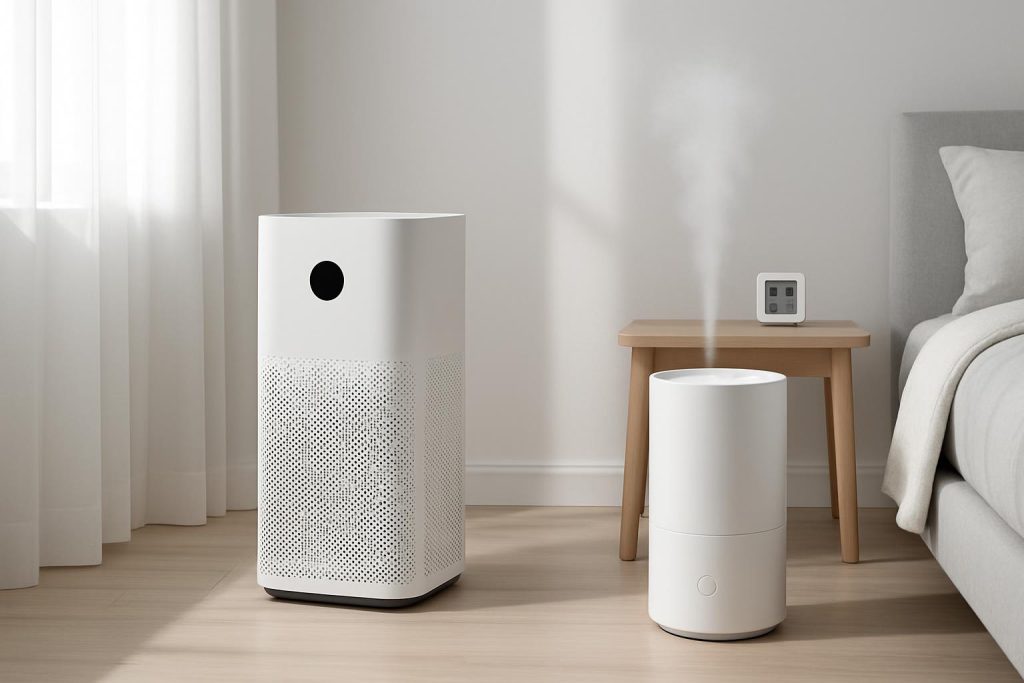
The key is not to place them right next to each other. I learned this the annoying way after setting both units on the same side table one winter. The humidifier made the air around the purifier too damp, and the purifier’s filter started smelling musty sooner than it should have. Once I moved them apart and started using a hygrometer to watch the humidity, the setup worked much better.
For most homes, the safest arrangement is to keep the air purifier and humidifier at least 3 to 6 feet apart, avoid pointing humidifier mist directly at the purifier, and keep indoor humidity around 40% to 50%. That gives you cleaner air without creating the damp conditions that can lead to mold, dust mites, or a wet filter.
Can you run an air purifier and humidifier in the same room?
Yes, you can run both in the same room, and it is often useful during dry seasons, allergy season, wildfire smoke events, or in homes with forced-air heating.
An air purifier and humidifier do not cancel each other out because they have different jobs:
Air purifier: captures airborne particles through a filter, usually a HEPA filter, and may include a carbon filter for odors.
Humidifier: adds water vapor or mist to the air to raise indoor humidity.
In my house, the issue showed up every winter. The heat would kick on, the air would get painfully dry, and everyone woke up with dry throats. At the same time, dust seemed to float around constantly because the windows stayed closed. Running a purifier helped with the dust and pet hair, while the humidifier made the air feel less harsh.
The combination can be especially helpful if you deal with:
Dry nose, throat, or skin in winter
Dusty indoor air
Pet dander
Pollen that gets tracked indoors
Smoke or cooking odors
Static electricity from very dry air
Dry cough irritation made worse by low humidity
The part people often miss is that more humidity is not always better. A humidifier can make a room more comfortable, but too much moisture creates a new set of problems.
Where should you place an air purifier and humidifier?
The best setup is to place the air purifier and humidifier several feet apart, ideally on opposite sides of the room or at least far enough that mist from the humidifier cannot reach the purifier directly.
A good rule in a bedroom or living room is:
Keep them at least 3 feet apart as a minimum.
6 feet or more is better if your humidifier produces visible mist.
Do not aim the humidifier toward the purifier.
Do not place either unit tight against a wall, curtain, sofa, or bed.
Keep the purifier’s intake and outlet vents clear.
I’ve had the best results placing the air purifier closer to the area where air movement is useful, such as near the bedroom door or a pet bed, while keeping the humidifier closer to the center of the room but away from electronics and wood furniture.
If your humidifier leaves a damp patch on the floor, furniture, or nearby wall, it is too close to surfaces or running too high. That moisture can also get pulled into the air purifier if the units are nearby.
Should the humidifier be near the bed?
It can be near the bed, but not so close that mist lands on your bedding or nightstand. I try to keep mine a few feet from the bed and pointed into open space. If you wake up with a damp pillowcase, wet nightstand, or condensation on the window, the humidifier is either too close, too strong, or running too long.
Should the air purifier be near the humidifier?
No. The purifier should not sit directly beside the humidifier. Moist air pulled straight into a filter can shorten the filter’s life, cause odor, and in some cases encourage microbial growth inside a dirty or damp filter.
What humidity level is best when using both?
For most homes, aim for indoor humidity between 40% and 50%. This range usually feels comfortable without making the room damp.
The general healthy indoor humidity range is often listed as 30% to 50%, but I personally try not to push past 50% for long. Once my house gets into the mid-50s, windows start showing condensation in cold weather, and the room begins to feel a little heavy.
A simple digital hygrometer is one of the best cheap tools for this setup. Many humidifiers have built-in humidity readings, but I’ve found they can be off because they measure the air right near the machine. A separate hygrometer placed across the room gives a better picture of what you are actually breathing.
Humidity Level | What It Usually Means | What To Do |
|---|---|---|
Below 30% | Air is very dry; dry throat, static, cracked skin may worsen | Use a humidifier, preferably with a humidity setting or timer |
30% to 40% | Acceptable for many homes, though some people still feel dry | Run humidifier lightly if needed |
40% to 50% | Comfortable target range for most rooms | Maintain this range and keep the purifier running normally |
50% to 60% | Can feel muggy; condensation may begin in cold weather | Lower humidifier output or run it for shorter periods |
Above 60% | Higher risk of mold, dust mites, musty smells, and damp surfaces | Turn off humidifier and ventilate or dehumidify if needed |
If your room already sits above 50% humidity, you probably do not need a humidifier. In that case, the air purifier alone may be the better choice.
Can a humidifier damage an air purifier?
A humidifier can damage or reduce the performance of an air purifier if the purifier is exposed to too much moisture. The risk is highest when a misting humidifier is placed too close to the purifier or pointed directly at it.
Here is what can go wrong:
Damp filters: A wet HEPA filter can become less effective and may develop a musty odor.
Mineral dust: Ultrasonic humidifiers can release white mineral dust if you use hard tap water. The purifier may capture some of it, clogging the filter faster.
Mold risk: Moisture plus dust inside a filter is not a good mix, especially if filter changes are overdue.
Sensor confusion: Some air purifiers with air quality sensors may react to water droplets or mineral particles as if the air is polluted.
Electronics exposure: Moisture near electrical components is never ideal.
One common mistake is assuming the purifier will “clean” the humidifier mist. That is not how the setup should be used. The humidifier should put clean moisture into the room, and the purifier should clean airborne particles from normal room air. The purifier should not be treated like a filter for dirty humidifier output.
If your air purifier smells musty after you started using a humidifier, check the filter. Also check whether the humidifier is too close, whether room humidity is too high, and whether the humidifier itself needs cleaning.
What type of humidifier works best with an air purifier?
The best humidifier to use with an air purifier is usually an evaporative humidifier or a well-maintained ultrasonic humidifier used with distilled or demineralized water.
Each type has trade-offs. I’ve used both ultrasonic and evaporative models, and they behave differently in a room with an air purifier.
Humidifier Type | Pros | Concerns With Air Purifiers | Best Use |
|---|---|---|---|
Ultrasonic cool mist | Quiet, energy-efficient, adds moisture quickly | Can release white mineral dust with hard tap water; visible mist can wet nearby surfaces | Bedrooms, if used with distilled water and kept away from purifier |
Evaporative | Less likely to over-humidify; no visible mist; good for steady moisture | Has a wick/filter that needs regular replacement | Living rooms, bedrooms, larger spaces |
Warm mist | Can feel soothing in winter; no white dust in the same way ultrasonic units can create | Uses heat; burn risk around children or pets; may raise room temperature slightly | Adult bedrooms or controlled spaces |
Whole-house humidifier | Manages humidity throughout the home through HVAC | Needs proper maintenance; poor setup can encourage duct or mold issues | Homes with consistently dry air in winter |
If you have hard water, an ultrasonic humidifier can create a fine white powder on furniture. An air purifier may pull some of that dust into the filter, which sounds helpful at first, but it can clog the filter faster. Using distilled water or a demineralization cartridge helps reduce this problem.
Evaporative humidifiers are often more forgiving because they add moisture through evaporation instead of spraying mist into the air. They are not perfect, though. Their wicks can get crusty or smelly if neglected.
Should the air purifier run all day with a humidifier?
In many homes, the air purifier can run continuously, while the humidifier should run only as needed to maintain the right humidity.
Air purifiers usually work best with steady operation. A purifier that only runs for an hour here and there may reduce some particles, but dust, dander, and pollen keep re-entering the air as people move around, pets shed, and HVAC systems cycle.
Humidifiers are different. Running one nonstop can push humidity too high, especially in a closed bedroom overnight. That is why a humidifier with a built-in humidistat, auto mode, or timer is useful.
My usual winter routine looks like this:
Run the air purifier on low or auto most of the day.
Run the humidifier in the evening if humidity drops below about 40%.
Turn down or shut off the humidifier before humidity passes 50%.
Check windows in the morning for condensation.
Clean the humidifier often enough that the tank never gets slimy.
If someone in the house has asthma, allergies, COPD, frequent respiratory symptoms, or a compromised immune system, it is worth asking a healthcare professional about ideal humidity and indoor air changes. A humidifier can help dry-air irritation, but a dirty humidifier can make symptoms worse.
What are the most common mistakes people make?
The biggest mistakes are placing the two machines too close together, over-humidifying the room, and forgetting to clean the humidifier.
Here are the ones I see most often, including a few I’ve made myself:
Putting both units on the same table: Convenient, but not great if mist reaches the purifier.
Running the humidifier without checking humidity: Comfort can fool you. A room may feel cozy while humidity is already too high.
Using hard tap water in an ultrasonic humidifier: This can create white dust and clog purifier filters faster.
Ignoring filter replacement: A clogged purifier filter moves less air and may smell stale.
Letting water sit in the humidifier tank: Stagnant water can grow bacteria or mold.
Pointing mist at walls, wood furniture, or curtains: Moisture damage can happen slowly before you notice it.
Assuming a bigger humidifier is always better: Oversized units can make smaller rooms damp quickly.
A clean humidifier matters just as much as a good air purifier. If the humidifier smells off, has pink slime, visible scale, or a cloudy tank, stop using it until it is cleaned properly according to the manufacturer’s instructions.
Can using both help with allergies, dust, or dry air?
Using both can help make a room feel better, but they do not treat the same issue.
For allergies, the air purifier is usually the more important device. A true HEPA purifier can capture many airborne particles such as pollen, dust mite debris, mold spores, and pet dander. It will not remove allergens sitting deep in carpets, mattresses, or upholstery, so cleaning still matters.
For dry air, the humidifier is the useful device. Dry indoor air can irritate nasal passages, make skin feel tight, and worsen static electricity. Raising humidity into a comfortable range can make the room feel less harsh.
The combination may be helpful if you have both dry air and airborne irritants. For example, during winter I notice the purifier helps reduce the dusty smell that builds up when the house is closed, while the humidifier helps with the dry nose and scratchy throat feeling.
Still, neither machine fixes every indoor air problem. If you have visible mold, a roof leak, a damp basement, gas appliance issues, or strong chemical odors, those problems need source control, ventilation, repair, or professional help. A purifier and humidifier can support indoor comfort, but they should not cover up a serious moisture or air quality issue.
Is a 2-in-1 air purifier and humidifier a good idea?
A combined air purifier and humidifier can be convenient, but separate units are usually easier to place, clean, and control.
I understand the appeal of a 2-in-1 machine. Fewer cords, fewer devices, less floor space. For a small room or apartment, that can be tempting. The downside is that air purification and humidification have different placement needs. The purifier wants open airflow. The humidifier needs water handling and moisture control.
With separate units, you can place each one where it works best. You can also run the purifier all day and use the humidifier only when humidity drops. If one breaks, you replace one device instead of losing both functions.
A combo unit may make sense if:
You have limited space.
You are willing to clean it frequently.
The unit has a true HEPA filter and a reliable humidity control.
The water tank design is easy to access and dry.
I would be cautious with any unit that is vague about filter type, uses marketing terms instead of clear specifications, or has a water path that looks hard to clean. A humidifier that is difficult to clean is one you may eventually avoid cleaning, and that is where problems start.
How to use an air purifier and humidifier together safely
Here is the simple setup I recommend for most bedrooms and living rooms:
Place them apart: Keep at least 3 to 6 feet between the units.
Aim mist away: Never point visible mist at the purifier, wall, bed, or electronics.
Use a hygrometer: Keep humidity around 40% to 50%.
Use clean water: Distilled water is best for ultrasonic humidifiers, especially in hard-water areas.
Clean the humidifier regularly: Follow the manual. Empty, rinse, and dry it often.
Replace purifier filters on schedule: Check them sooner if you use a humidifier often or notice odors.
Watch for condensation: Wet windows are a warning sign that humidity may be too high.
Size both units correctly: A small purifier in a large room will struggle, and an oversized humidifier can overdo moisture.
If you only remember one thing, remember this: clean air plus comfortable humidity is the goal, not maximum purifier speed plus maximum mist. More is not always better.
FAQ about using an air purifier and humidifier together
Can I put a humidifier in front of an air purifier?
No, that is not a good setup. The purifier may pull in wet mist, mineral particles, or overly humid air. This can shorten filter life and may lead to musty smells. Keep the humidifier off to the side and several feet away.
Can I use both while sleeping?
Yes, as long as the room humidity stays in a safe range and the humidifier is clean. I prefer running the purifier on low overnight and using the humidifier on auto mode or a timer. Check the humidity in the morning to make sure the room is not getting damp.
Will an air purifier remove moisture from the air?
No. A standard air purifier does not dehumidify the air. It moves air through filters to capture particles. If your room is too humid, you need ventilation, air conditioning, or a dehumidifier, not an air purifier.
Will a humidifier make the air purifier less effective?
Not if they are used correctly. The purifier can still clean the air while the humidifier adds moisture. Problems start when humidity gets too high, mist reaches the purifier, or mineral dust from hard water clogs the filter.
Is distilled water really necessary in a humidifier?
For ultrasonic humidifiers, distilled water is strongly recommended if you have hard water. It reduces white dust and mineral buildup. For evaporative humidifiers, tap water is often more manageable, though scale can still build up and the wick needs replacement.
Why does my air purifier sensor spike when I run my humidifier?
Some sensors detect tiny water droplets or mineral particles from the humidifier and interpret them as airborne pollution. This is common with ultrasonic humidifiers using tap water. Try distilled water, move the machines farther apart, and avoid aiming mist toward the sensor.
Can a humidifier cause mold if I also use an air purifier?
Yes. An air purifier does not prevent mold caused by excess moisture. If humidity stays above 60%, or if mist dampens walls, carpets, curtains, or furniture, mold can grow. Control humidity first.
Which should I buy first: an air purifier or a humidifier?
If your main issue is dust, pet dander, pollen, smoke, or allergies, buy an air purifier first. If your main issue is dry throat, dry skin, static, or winter dryness, buy a humidifier first. If you have both problems, using both can make sense.
The best practical answer for most homes
You can use an air purifier and humidifier together, and the combination can make a room noticeably more comfortable. The safest way is to give each device space, keep humidity under control, and stay serious about cleaning.
My own setup is simple now: purifier running steadily, humidifier used only when the hygrometer shows dry air, and the two machines placed far enough apart that the purifier never pulls in mist. That has solved the dry winter air problem without creating musty filters or damp windows.
If your home is dry and dusty, using both devices is reasonable. Just resist the urge to crank the humidifier too high. Clean moisture and clean air work well together, but damp air and dirty equipment can quickly create the opposite of what you wanted.