
We are reader supported. When you purchase through links on our site, we may earn an affiliate commission. Also, as an Amazon affiliate, we earn from qualifying purchases.
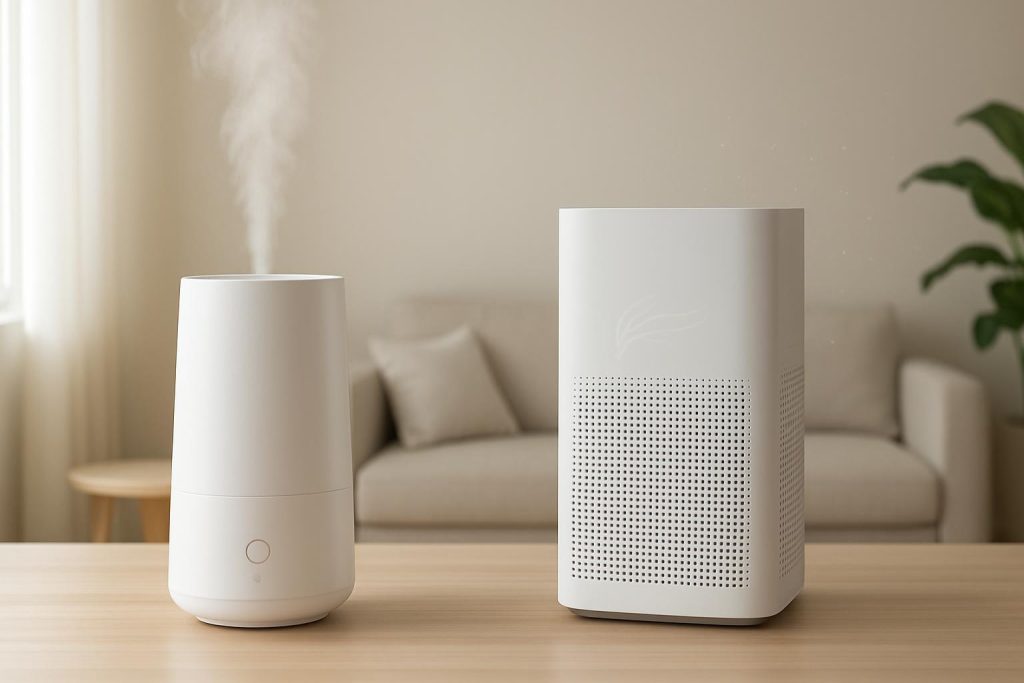
A humidifier and an air purifier solve two different indoor air problems. A humidifier adds moisture to dry air. An air purifier removes airborne particles like dust, pollen, pet dander, smoke, and some odors, depending on the filter.
If your nose, throat, skin, or wood furniture feels dried out in winter, a humidifier may help. If you are sneezing, reacting to dust, dealing with pet hair, smoke, musty smells, or allergy symptoms, an air purifier is usually the better first choice.
I learned this the hard way after buying a humidifier for what I thought was “bad air” in my house. The bedroom felt stuffy, my sinuses were irritated, and I assumed moisture was the missing piece. The humidifier helped with dry lips and morning throat scratchiness, but it did nothing for the dust floating in the sunlight or the allergy flare-ups after vacuuming. That problem needed filtration, not humidity.
The short version: a humidifier changes the moisture level in the air. An air purifier cleans the air. Some homes need one. Some need both. Using the wrong one can waste money or even make the problem worse.
What is the main difference between a humidifier and an air purifier?
A humidifier increases indoor humidity by releasing water vapor or mist into the room. It does not remove dust, pollen, mold spores, smoke particles, pet dander, or germs from the air in any meaningful way.
An air purifier pulls air through filters and traps airborne pollutants. A good purifier with a true HEPA filter can capture very small particles, including pollen, dust mite debris, many mold spores, pet dander, and smoke particles. If it has an activated carbon filter, it can also reduce some odors and certain gases, though carbon filters vary a lot in quality.
| Problem | Humidifier | Air Purifier |
|---|---|---|
| Dry throat, dry skin, cracked lips | Helps by adding moisture | Usually does not help directly |
| Dust in the air | Does not remove it | Helps capture airborne dust |
| Seasonal allergies | May soothe dryness, but does not remove pollen | Often helpful with a HEPA filter |
| Pet dander | Does not remove it | Helps reduce airborne dander |
| Smoke or wildfire particles | Does not clean smoke | Helps with HEPA and carbon filtration |
| Static electricity in winter | Can help if air is too dry | Does not fix low humidity |
| Musty smell | May make it worse if humidity gets too high | May reduce odor, but moisture source still needs fixing |
The easiest way to choose is to identify whether your home has a moisture problem or a particle problem. If the air feels dry and your humidity is below about 30%, look at a humidifier. If the air feels dusty, smoky, allergenic, or stale, look at an air purifier.
Do I need a humidifier or an air purifier for allergies?
For allergies, an air purifier is usually the more useful device. Allergies are commonly triggered by airborne particles such as pollen, dust mite waste, pet dander, and mold spores. A humidifier does not remove those triggers from the air.
That said, humidity still matters. Very dry air can irritate your nose and throat, which can make allergy symptoms feel worse. I noticed this during winter: the purifier reduced sneezing, but my nose still felt raw in the morning until I got the bedroom humidity out of the low 20% range.
For allergy-prone homes, the practical setup is often:
- Air purifier in the bedroom, sized for the room and run continuously on a quiet setting.
- Humidity kept around 40% to 50%, especially during heating season.
- Regular cleaning, including bedding, rugs, and vacuuming with a good filter.
- Source control, such as keeping windows closed on high-pollen days.
Be careful with humidifiers if you are allergic to dust mites or mold. Dust mites thrive in higher humidity, and mold can grow when moisture collects on walls, windows, carpet, or inside the humidifier itself. More moisture is not always better.
A common mistake is running a humidifier all night without checking the humidity level. If windows are fogged up in the morning or there is moisture on the sill, the room is probably too humid. That can create a new allergy problem instead of solving the old one.
Will a humidifier clean the air?
No, a humidifier should not be treated as an air-cleaning device. It may make dry air feel more comfortable, but it does not filter out pollutants.
Some people think a humidifier “weighs down” dust so it falls out of the air. In real homes, that is not a reliable cleaning strategy. Even if a little dust settles faster in moister air, the dust is still in the room, and you still breathe plenty of airborne particles.
Even worse, a poorly maintained humidifier can add unwanted material to the air. I once ignored the light mineral crust forming around an ultrasonic humidifier because the tank looked clean enough. A week later, there was fine white dust on the dresser. That dust came from minerals in tap water being released into the room as mist.
That does not mean humidifiers are bad. They are useful when used correctly. But they need maintenance:
- Use distilled or demineralized water in ultrasonic models if your tap water is hard.
- Empty and dry the tank regularly.
- Clean the unit according to the manufacturer’s instructions.
- Replace wicks or filters on schedule.
- Use a hygrometer so you are not guessing the humidity.
If your main concern is dust, smoke, pollen, dander, or indoor air pollution, start with an air purifier rather than a humidifier.
What does an air purifier actually do?
An air purifier moves room air through one or more filters. The most useful type for common household particles is a true HEPA filter. HEPA filters are designed to capture extremely small particles, which is why they are commonly recommended for allergy and smoke concerns.
Many air purifiers include:
- Pre-filter: Captures larger particles like hair and lint.
- HEPA filter: Captures fine particles such as pollen, dust, dander, and smoke particles.
- Activated carbon filter: Helps reduce odors and some gases.
Air purifiers work best when they are properly sized. A tiny purifier in a large living room will run loudly and still underperform. Look for the CADR rating, which stands for Clean Air Delivery Rate. Higher CADR means the unit can clean more air faster.
In my own home, moving from a small bargain purifier to a properly sized bedroom unit made a noticeable difference. The smaller one was not useless, but it only helped if I sat right next to it. The larger unit could actually cycle the room air several times per hour.
Air purifiers also have limits. They do not remove dust already settled on shelves. They do not fix mold growing behind drywall. They do not solve pet allergies if the pet sleeps on your pillow. They help reduce airborne particles, but they work best alongside cleaning, ventilation, and controlling the source of the problem.
Which one is better for dry air, cough, and sinus irritation?
If your home’s air is dry, a humidifier is usually the better tool. Dry indoor air is common in winter because heating systems warm the air and lower relative humidity. Symptoms can include:
- Dry nose or nosebleeds
- Scratchy throat in the morning
- Dry, itchy skin
- Cracked lips
- Static shocks
- Wood floors or furniture shrinking or creaking
A humidifier can make a bedroom feel much more comfortable during cold months. The key is staying in a healthy humidity range. For most homes, about 30% to 50% relative humidity is a good target. I aim for around 40% in winter because it feels comfortable without creating condensation on the windows.
If you have a cough, a humidifier may soothe irritation caused by dry air. But it will not treat the cause of a cough, and it can be the wrong choice if the cough is triggered by mold, dust mites, or poor air quality. For ongoing breathing symptoms, asthma, or frequent coughing, it is worth checking with a healthcare professional rather than relying only on appliances.
An air purifier may help if your cough is triggered by smoke, dust, pet dander, or pollen. In that case, adding moisture alone may do little.
Can you use a humidifier and an air purifier in the same room?
Yes, you can use both in the same room, and many people do. I use an air purifier year-round in the bedroom and bring out the humidifier mostly during winter. They solve separate problems, so there is no reason they cannot work together.
There are a few practical rules that make the combination work better:
- Do not place the humidifier right next to the purifier. Mist can dampen the purifier filter and reduce performance.
- Keep the humidifier mist away from walls, curtains, bedding, and wood furniture. Moisture buildup can lead to damage or mold.
- Use a hygrometer. Guessing humidity by feel is unreliable.
- Run the purifier continuously. Air cleaning works best as a steady process, not a once-a-day blast.
- Clean the humidifier often. A dirty humidifier can work against your air purifier by releasing impurities into the room.
If the humidifier produces visible mist, give it some distance from the purifier. A few feet is better than side-by-side. With an evaporative humidifier, this is less of a concern because it releases moisture through a wet wick rather than a visible plume, but spacing still helps.
Which is better for mold: a humidifier or an air purifier?
For mold concerns, an air purifier can help reduce airborne mold spores, but it does not fix the moisture problem that allows mold to grow. A humidifier can make mold worse if the home is already damp.
If you smell mustiness, see spots on walls or ceilings, or notice recurring condensation, do not add humidity. Look for the water source first. That may be a roof leak, plumbing leak, wet basement, poor bathroom ventilation, or humidity that is too high.
In a mold-prone room, the better tools may be:
- A dehumidifier, if humidity is high
- Bathroom or kitchen exhaust fans
- Leak repair
- Improved drainage or basement sealing
- An air purifier with HEPA filtration as a supporting measure
A purifier can make the air feel better while you address the source, but it should not be used as a cover-up for active mold growth. If mold covers a large area or keeps returning, professional assessment may be needed.
What should I buy first?
The quickest way to decide is to measure humidity and identify your main symptom. A simple digital hygrometer costs very little and removes the guesswork. I keep one in the bedroom because the air can feel “bad” for different reasons on different days.
| Your situation | Buy first | Why |
|---|---|---|
| Humidity is below 30% and you have dry skin, dry nose, or static | Humidifier | The air likely needs moisture |
| You have allergies, pets, pollen, dust, or smoke | Air purifier | You need particle removal |
| Room smells musty or feels damp | Neither as the first fix | Find and reduce moisture; a dehumidifier may be needed |
| Winter air is dry but you also have dust allergies | Both may help | Humidifier improves comfort; purifier reduces airborne allergens |
| You live near traffic, wildfire smoke, or frequent outdoor pollution | Air purifier | Filtration is the priority |
If I had to choose one for the average home with no humidity measurement, I would start with the air purifier for allergy, dust, pet, or smoke complaints. I would start with the humidifier only if the signs clearly point to dry air.
For bedrooms, quiet operation matters. A purifier or humidifier that is too loud will end up unplugged. Look for units that can handle the room size on a lower setting, not just on the loudest fan speed.
What type of humidifier is best for home use?
Humidifiers come in a few common styles. The right one is often the one you can keep clean without hating the process.
Evaporative humidifiers
These use a fan to blow air through a wet wick. They are simple and less likely to over-humidify because evaporation naturally slows as the air becomes more humid. The downside is that the wick needs replacing, and the fan makes some noise.
Ultrasonic humidifiers
These create a fine mist using vibration. They are usually quiet and energy-efficient. The downside is mineral dust if you use hard tap water, plus the need for careful cleaning. I like them for bedrooms only when using distilled water.
Warm mist humidifiers
These heat water to create steam that cools before leaving the unit. They can feel comforting in winter, but they use more electricity and can be a burn risk around children or pets.
Whole-house humidifiers
These connect to an HVAC system and humidify the whole home. They can be convenient, but installation and maintenance matter. If they are neglected, they can create duct or mold issues. They are best for homes with consistent winter dryness and homeowners who are willing to maintain them properly.
What type of air purifier is best?
For most homes, choose an air purifier with a true HEPA filter and a CADR rating that matches the room size. If odors, smoke, cooking smells, or VOCs are a concern, look for a unit with a substantial activated carbon filter, not just a thin black sheet.
I avoid air purifiers that rely heavily on ozone or ionization. Some ionizers can produce ozone, which can irritate lungs. If a product advertises “fresh mountain air” or “ozone cleaning,” I would be cautious, especially in bedrooms or homes with children, older adults, or anyone with asthma.
Good purifier features include:
- True HEPA filtration
- Appropriate CADR for the room
- Replacement filters that are easy to find
- Quiet sleep mode
- No required ozone feature
- Simple controls you will actually use
Also check filter costs before buying. Some cheap purifiers become expensive because filters need frequent replacement or are hard to find after a year.
Common mistakes people make with humidifiers and air purifiers
The biggest mistake is expecting one device to do the other’s job. A humidifier will not remove allergens. A purifier will not fix dry winter air.
Other common mistakes include:
- Running a humidifier without measuring humidity. This can lead to condensation, mold, and dust mite growth.
- Using tap water in an ultrasonic humidifier. Hard water can create white dust around the room.
- Forgetting to clean the humidifier. A dirty tank can spread unpleasant particles or odors.
- Buying an undersized air purifier. A small purifier in a large room will disappoint you.
- Turning the purifier on only after symptoms start. Purifiers work better when run continuously.
- Ignoring the source of the problem. Air appliances help, but they do not replace fixing leaks, cleaning dust, or changing HVAC filters.
Another mistake is placing the device poorly. A purifier needs open airflow. Do not shove it behind furniture or trap it in a corner behind curtains. A humidifier needs space so mist can disperse without soaking nearby surfaces.
Simple decision guide for your home
If you want the fastest answer, use this checklist:
- Buy a humidifier if your indoor humidity is low and you have dry-air symptoms.
- Buy an air purifier if your symptoms are linked to dust, pets, pollen, smoke, or odors.
- Use both if winter dryness and airborne allergens are both problems.
- Do not use a humidifier to solve musty smells, visible mold, or damp rooms.
- Consider a dehumidifier if humidity is regularly above 55% to 60%.
For my house, the best setup was not one magic appliance. It was a bedroom air purifier running daily, a humidifier only during dry months, and a small hygrometer to keep me honest. That combination solved more than either device did alone.
FAQ: Humidifier vs air purifier
Can an air purifier make the air dry?
No. An air purifier does not remove moisture from the air. It may make the room feel fresher because it moves and filters air, but it does not lower humidity like a dehumidifier or air conditioner can.
Can a humidifier help with dust?
Not in a reliable way. A humidifier may slightly change how dust behaves in the air, but it does not capture or remove dust. For dust problems, use an air purifier, clean surfaces regularly, wash bedding, and check HVAC filtration.
Is it safe to sleep with a humidifier on?
Yes, if the humidifier is clean and the room humidity stays in a healthy range. Use a hygrometer and avoid letting humidity climb high enough to cause condensation. Place the unit where mist will not blow directly onto bedding, walls, or electronics.
Is it safe to sleep with an air purifier on?
Yes. Air purifiers are often most useful in bedrooms because you spend many hours there. Choose a non-ozone-producing unit with a true HEPA filter and a quiet sleep setting.
Which is better for babies: humidifier or air purifier?
For dry air, a cool-mist humidifier can help keep a nursery more comfortable, but it must be cleaned carefully. For allergens, smoke, or pet dander, a HEPA air purifier is more appropriate. Avoid warm mist units where burns are a concern, and avoid ozone-generating air cleaners.
Can I put essential oils in a humidifier?
Only if the manufacturer specifically says the unit is designed for essential oils. Many humidifiers are not. Oils can damage plastic parts, clog components, and release irritating compounds into the air. I do not use oils in mine, especially in bedrooms.
What humidity level should I keep at home?
A good target for many homes is 30% to 50% relative humidity. In winter, staying near 40% often feels comfortable. If you see condensation on windows, damp walls, or musty smells, reduce humidity.
Do I need an air purifier if I already have an HVAC filter?
Maybe. A good HVAC filter helps, but it only filters air while the system fan is moving air, and it may not clean a bedroom as effectively as a dedicated room purifier. A portable purifier can be especially helpful where you sleep or spend the most time.
Can a humidifier make allergies worse?
Yes, if humidity gets too high or the humidifier is dirty. High humidity encourages dust mites and mold. Keep humidity controlled and clean the unit often.
Should I buy a combo humidifier and air purifier?
Combo units can be convenient, but they often involve compromises. Some are harder to clean, have smaller tanks, or do not purify as well as a dedicated air purifier. I prefer separate units because each one can be placed, cleaned, and sized properly. A combo unit may make sense for a small room if the specifications are strong and maintenance is simple.