
We are reader supported. When you purchase through links on our site, we may earn an affiliate commission. Also, as an Amazon affiliate, we earn from qualifying purchases.
Clean tint lines start with the right squeegee. The wrong blade leaves fingers, trapped water, and small scratches that show up the second the sun hits the glass. I have tested dozens of options across auto and flat-glass installs. Below are four pro-level picks that stay in my kit in 2026. Each one has a specific job, so you can build a simple, efficient setup and stop fighting your film.
What Matters Most in a Window Tint Squeegee
Blade hardness and edge profile
Harder blades push out more fluid and set edges cleaner. Softer blades conform to curves but may leave more moisture if you press lightly. Straight edges cover large flats. Angled tips reach deep at gasket lines and corners. Mixing one hard, one soft, and one angled tool solves most installs.
Size and control
Five-inch squeegees are the workhorse. They balance coverage and control, especially on door glass. Smaller utility squeegees and pointed tools handle pillars, top edges, and tight curves. A handle can help with leverage on back glass, but a palm grip gives better feel on side windows.
Surface safety
Felt or fabric-wrapped edges glide on delicate films and PPF without scratching. Bare urethane is fine on wet surfaces but needs clean solution and no debris. Always flush the blade before the final pass.
Durability and maintenance
Quality urethane holds its edge longer and resists nicks. Rinse between panels. Wipe with a clean, lint-free towel. Replace when the edge rounds off or shows chips. A nicked edge will print lines into the adhesive.
4 Best Squeegees for Window Tinting in 2026
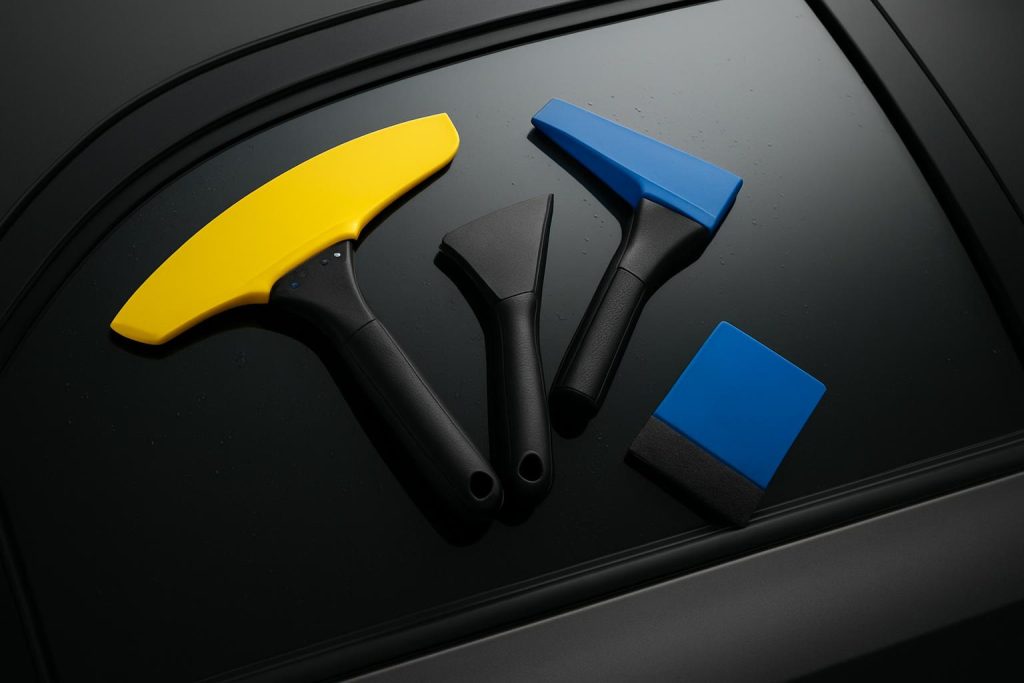
VViViD Yellow Turbo Squeegee 5 inch
Why this pick: A classic for automotive side glass. The Yellow Turbo has the right stiffness to move water fast without chattering. It fits the hand well, glides on slip solution, and reaches close to gaskets with a low, tapered edge.
Key specs:
- 5-inch urethane blade, medium-firm
- Curved ergonomic profile for palm grip
- Slightly beveled edge for smooth release
Why it helps: Consistent pressure across the blade gives you clean, streak-free sweeps. The medium hardness keeps the film steady while you work out solution without stretching it.
Best for: Door glass, quarter windows, most mid-size curved panels.
What I think: I reach for this first on side windows. It is fast, predictable, and forgiving. On stubborn edges, I pair it with a pointed tool for the last half inch under the seal.
Potential downsides: Not as strong as Blue Max on heavy back-glass fluid. The edge will show wear if you run it dry or across debris.
Pro tip: Keep the panel wetter than you think for your first two passes. Use firm, even strokes, then finish with lighter pressure to avoid micro drag lines.
Blue Max 5 inch Angled Squeegee Blade
Why this pick: The pro choice for deep water evacuation. Blue Max is firm and efficient, and the angled edge reaches tight borders and sweeps corners clean. It shines on back glass and large panes where you need maximum fluid removal in fewer passes.
Key specs:
- 5-inch firm urethane blade
- Angled cut for edge access
- Compatible with hand use or handle tools
Why it helps: A firm blade transfers your pressure to the fluid, not the film. That speeds up install time and lowers the risk of trapping moisture, especially across defroster lines and compound curves.
Best for: Back glass, sunroofs, flat-glass panels, and final passes on large areas.
What I think: When I need a panel bone dry and locked down, I swap to Blue Max. It cuts out the last haze fast, which reduces rework and call-backs.
Potential downsides: Too aggressive if you are heavy-handed on very thin films. Cleanliness is key; any grit will telegraph under a firm edge.
Pro tip: Use a lighter slip mix on your final set pass so Blue Max does not hydroplane. Control your angle at about 10–15 degrees to the glass to avoid lift.
Conqueror Squeegee and Scraper
Why this pick: A dual-purpose classic. One side works as a semi-firm squeegee for edges. The pointed tip gets behind gaskets and into tight corners. The flat edge handles small sweeps and cleanup. It reduces tool swapping on each window.
Key specs:
- Hybrid design with pointed tip
- Semi-firm polymer
- Compact footprint for control
Why it helps: You can set top edges, chase small fingers, and clear corners with one tool. That speeds up side glass installs and reduces edge lift from repeated passes.
Best for: Top gasket lines, tight corners, small fixed windows, and final edge set.
What I think: I keep this in my other hand during side glass installs. It is the fastest way to clean up the last few millimeters that a 5-inch blade cannot reach.
Potential downsides: Not ideal for big fluid moves. Use a true 5-inch blade for the main sweeps, then switch to Conqueror for details.
Pro tip: Wrap the tip with a thin microfiber edge for the first edge set on delicate films, then remove the wrap for final pressure once placement is locked.
3M Blue Squeegee With Felt Edge
Why this pick: A soft-touch edge that protects sensitive films. The felt wrap glides over tint without scuffing, helpful on top-coat sensitive films and near ceramic-dot areas. It is also good for dry shrinking with a buffer layer.
Key specs:
- Flexible polymer card with felt edge
- Compact size for control
- Low-friction felt contact surface
Why it helps: The felt interface lowers surface friction. That reduces the risk of micro marring on softer films and lets you finesse edges when the panel is almost dry.
Best for: Sensitive top coats, dot matrix areas with a buffer, and edge finishing where scratch risk is high.
What I think: I use this for final detailing when I want a clean, safe glide along the top edge and around sensors or frit. It also helps cushion pressure when a firm blade feels risky.
Potential downsides: The felt will hold contamination if you do not keep it clean. It moves less fluid than a bare urethane blade.
Pro tip: Keep a spray bottle handy to rinse the felt often. Replace the felt wrap when it pills or shows embedded debris.
How to Choose the Right Combo
Build a two- or three-tool kit
– A 5-inch medium blade for general sweeps. VViViD Yellow Turbo covers this.
– A firm blade for final set and big moisture moves. Blue Max fits here.
– A precision edge tool for corners and gaskets. Conqueror handles detail.
– Optional soft-touch finisher. 3M felt-edge card protects sensitive zones.
Match hardness to film and glass
Thicker films and back glass benefit from firm blades. Thin films and curved side windows feel safer with medium or soft edges. If you see micro lift or chattering, either lighten the pressure or switch to a softer tool for that step.
Consider your slip solution
Heavier soap mixes reduce friction on initial placement. For final set, a lighter mix helps firm blades pull water rather than skate. Adjust mix based on blade feedback. If the blade chatters, add a touch more slip. If it glides without moving water, reduce slip.
Step-by-Step: Squeegee Technique That Works
Prep and placement
– Clean the glass thoroughly. Scrub, rinse, and blade off. Any grit will scratch the film and the squeegee.
– Wet the glass and the adhesive side of the film evenly.
– Float the film into position. Tack the center with light pressure.
First passes
– Use the medium 5-inch blade. Start from the center and sweep out in overlapping strokes.
– Keep your angle low and pressure steady. Reload slip as needed to avoid dry spots.
Edge set
– Switch to Conqueror for top edges and corners. Work from the center out. Do not jam under the seal; ease under with short strokes and controlled pressure.
Final set
– Switch to Blue Max. Reduce slip slightly. Cross-squeegee your earlier path to chase out the last moisture.
– Finish with the 3M felt-edge card along sensitive areas to avoid micro scratches.
Common Mistakes and Fast Fixes
Blade chatter
Cause: Too little slip or too steep an angle.
Fix: Add slip, lower the squeegee angle, and smooth your stroke speed.
Edge lift after setting
Cause: Overworking the same line or pushing air back under the film.
Fix: Use shorter, outward strokes with a precision edge tool. Lock edges after the main water is out, not before.
Micro scratches or haze
Cause: Debris on the blade or too firm a blade on a nearly dry surface.
Fix: Rinse the blade, increase lubrication on intermediate passes, finish with a felt-edge tool.
Care and Maintenance
Keep blades clean
Rinse your squeegee every few passes. Wipe with a lint-free towel. Do not set blades face-down on dusty mats or tool carts.
Inspect edges
Run a fingertip along the edge before each panel. If you feel nicks or roughness, retire it. A damaged edge will print lines into the adhesive that will not disappear.
Rotate tools
Use the medium blade for most work and save the firm blade for final sets. This spreads wear and keeps each tool sharp for its role.
Why These Four Cover Everything
– A medium 5-inch blade for speed and control.
– A firm 5-inch blade for maximum water evacuation.
– A precision hybrid for corners and gaskets.
– A felt-edge finisher for sensitive zones.
I think this mix reduces mistakes and shortens install times. It also makes results repeatable across different films and vehicles.
Conclusion
Clean installs come from simple, proven tools used the right way. VViViD Yellow Turbo handles most sweeps. Blue Max locks down big panels and back glass. Conqueror cleans edges and corners. The 3M felt-edge card protects delicate areas when the panel is almost dry. Keep them clean, choose the right blade for each step, and you will see fewer fingers, fewer revisits, and a better finish every time.
FAQ
Q: Which squeegee is best for beginners?
A: A 5-inch medium blade like the VViViD Yellow Turbo is the easiest to control for most side windows.
Q: Do I need more than one squeegee to tint a car?
A: Yes. Use a medium 5-inch blade for main sweeps, a firm blade like Blue Max for final set, and a precision tool such as Conqueror for edges. A felt-edge card helps on sensitive areas.
Q: How do I avoid scratching the film with a squeegee?
A: Keep the blade clean, maintain good slip during early passes, and finish with a felt-edge card on sensitive zones.
Q: What size squeegee works best for tight corners and edges?
A: A compact precision tool like the Conqueror with a pointed tip reaches tight corners and gasket lines better than a 5-inch blade.
Q: When should I replace a squeegee blade?
A: Replace it when you feel nicks or the edge rounds off, since a damaged edge will leave visible lines or haze in the adhesive.