
We are reader supported. When you purchase through links on our site, we may earn an affiliate commission. Also, as an Amazon affiliate, we earn from qualifying purchases.
Getting a smooth, bubble-free epoxy coat starts before you open the can. The right squeegee controls thickness, moves material efficiently, and leaves a tight surface that self-levels without ridges. With the wrong tool, you fight lap lines, fisheyes, and air pockets. With the right one, the floor or countertop lays down fast and cures like glass. Below are four proven squeegees that make epoxy spreading easier, cleaner, and more predictable, plus clear guidance on when to use notched versus flat blades and how to avoid bubbles.
What matters in an epoxy squeegee
Width and coverage control
Wider blades cover more ground and reduce lap lines. For most garage floors, 18 to 24 inches is the sweet spot. For countertops, backsplashes, and stairs, compact spreaders in the 3 to 6 inch range offer better control.
Notched versus flat
Notched squeegees meter product thickness, great for consistent build on floors. Flat squeegees and squeegee trowels excel at final smoothing and topcoats. Many pros pull with a notched blade first, then switch to a magic trowel or squeegee trowel to knock down ridges.
Blade material and flexibility
Flexible blades glide over minor highs and lows and help release air. Stiffer blades push thicker resins with authority. Urethane, neoprene, and specialized flexible trowel blades are standard choices. Solvent resistance and easy cleanup matter if you work with tinted or fast epoxies.
Handle compatibility
A standard threaded socket lets you attach a pole so you can stand, reach, and keep a consistent pull angle. For countertops, a hand grip or palm-sized spreader is safer and more precise.
Replaceable parts
Replaceable blades extend tool life and keep edges crisp. Dull or nicked edges create streaks and micro-ridges that show in the cured finish.
How I choose and use these tools
I look for tools that control thickness without fighting me. On larger floors, I start with a notched squeegee to get even coverage fast, then switch to a flexible squeegee trowel for a light final pass. On counters or tight edges, I use compact, flexible spreaders to push material without spilling over the side. I think this two-step approach reduces bubbles and almost eliminates lap lines when you keep a wet edge and move steadily.
The 4 best squeegees for spreading epoxy
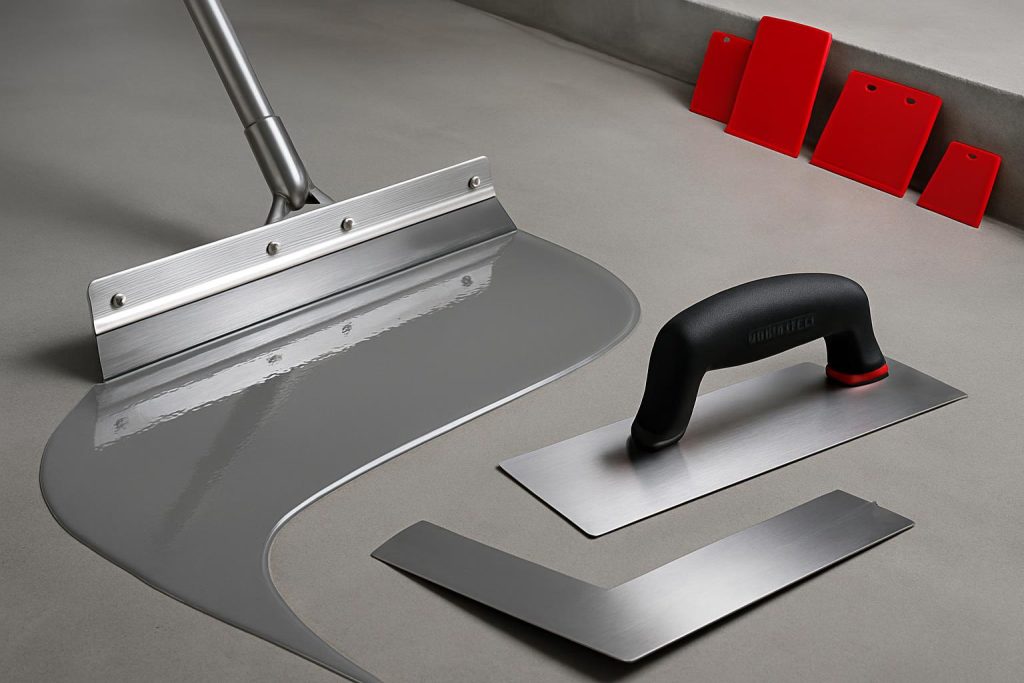
Midwest Rake SpeedSqueegee, 24 inch, notched blade
This is a go-to for metered coverage on garage floors and large rooms. Available in multiple notch sizes, it lays a predictable film that self-levels without constant back-rolling.
Why it helps: A notched edge meters epoxy thickness, so coverage stays even across the entire pull. That consistency reduces pooling, dry spots, and trapped air. A 24 inch width keeps passes wide and uniform.
Best for: Base coats and build coats on floors where you want a target mil thickness and fast, uniform coverage.
Standout features: Wide head, precision notches, and a handle socket that takes a standard extension pole. The blade has the right balance of flex and push, so it glides but still moves heavy material.
How to use it for a smooth, bubble-free finish: Pour ribbons of epoxy and pull at a steady pace with a slight angle. Let the notches do the metering. Keep overlapping passes wet on wet. Follow with a quick pass using a flexible trowel or a light spiked roll if your system calls for it.
Potential downsides: Notches leave ridges that you must knock down with a finishing pass if you want a glassy surface. If you pick the wrong notch size, you can overbuild or underbuild. It is best to match notch size to the product’s target coverage.
I think: When I want repeatable coverage on a floor, this tool sets the pace and puts material where it needs to go. It removes the guesswork from film build, which cuts down on rework.
Marshalltown Squeegee Trowel, 22 inch, DuraSoft handle
This is a flexible squeegee trowel that excels at finishing coats and knocking down ridges without introducing new lines. It is an ideal partner after a notched pull.
Why it helps: The flexible blade rides the surface and gently levels peaks. It reduces micro-bubbles by smoothing the top skin, which helps air escape during self-leveling.
Best for: Finish passes on floors, topcoats that need a glassy look, and quick touch-ups where the notched squeegee left faint lines.
Standout features: Comfortable handle, balanced flex, and a wide blade that covers ground without chatter. It works well at a low angle, which is key for keeping air out of the film.
How to use it for a smooth, bubble-free finish: Hold at a low angle with light pressure and make long, overlapping passes. Keep the blade clean. Use it immediately after your notched pull while the epoxy is still moving. Watch the surface under raking light and do not overwork.
Potential downsides: Too much pressure can micro-scrape the surface and create faint chatter if the blade picks up grit. It is not a metering tool, so you still need a notched squeegee for precise build coats.
I think: This is the tool that erases your tracks. Every time I add a quick finishing pass with a squeegee trowel, I get fewer touch-ups after cure and a clearer, cleaner top.
TexMaster Magic Trowel, 18 inch
This flexible magic trowel is a favorite for epoxy smoothing, self-leveling overlays, and microtoppings. It is especially forgiving for beginners because it glides with minimal pressure.
Why it helps: The soft, flexible blade skims the surface and relaxes ridges without dragging. That low-friction feel lets you float material and reduce air entrapment.
Best for: Final smoothing on floors, small to mid-size spaces where an 18 inch width is easier to steer, and thin epoxy topcoats that must look flawless.
Standout features: Smooth edge, forgiving flex, and an easy learning curve. It shines in the last 5 percent of the job where perfection shows, such as near light sources and doorways.
How to use it for a smooth, bubble-free finish: Pull at a very low angle using light, even pressure. Work in long arcs to blend lanes. If your system includes a spiked roller, do that first, then skim with the magic trowel to relax roller marks without trapping new air.
Potential downsides: It will not meter film thickness. On very large floors, the narrower 18 inch width means more passes than a 22 or 24 inch tool. The blade edge must stay clean or it can leave faint trails.
I think: If you want that final, wet-looking surface without a learning curve, this tool is hard to beat. It is also a smart upgrade if you often work near baseboards and tight spots where control matters.
Red Devil 4718, 3 piece plastic spreaders
For countertops, backsplashes, steps, and edge work, compact plastic spreaders give you control a big floor squeegee cannot. This set covers small, medium, and larger hand spreads.
Why it helps: The flexible edges let you push epoxy into corners and tight edges without drips. You can keep a wet edge on small surfaces and correct low spots on the fly.
Best for: Countertops, bar tops, stairs, patching, and cutting in along walls before switching to a larger floor tool.
Standout features: Multiple sizes in one set, easy to hold with gloves, and a flexible edge that conforms to slight curves and bevels. Cleanup is fast if you wipe between passes.
How to use it for a smooth, bubble-free finish: Pre-seal porous edges, then pour small amounts of epoxy and spread in short, overlapping strokes. Keep the blade clean. Finish with a light pass to erase lines. On wide counters, you can follow with a magic trowel for uniform gloss.
Potential downsides: Not for large floors. Plastic edges can nick if you hit fasteners or sharp substrate edges, so inspect the edge as you go.
I think: For small surfaces, these spreaders are the difference between chasing drips and having a controlled, even film. They live in my kit for every edge and countertop job.
Technique tips for a glassy, bubble-free epoxy coat
Prep and prime
Clean, profile, and vacuum the surface thoroughly. Pre-seal porous concrete and wood. A thin prime coat reduces off-gassing and helps the main coat flow.
Pour strategy
Mix accurately and follow the manufacturer’s pot life. Pour in ribbons, not large puddles. Ribbons spread faster and reduce trapped air under the blade.
Use the right tool in the right order
– For floors needing a measured build, start with a notched squeegee like the Midwest Rake.
– Follow with a flexible squeegee trowel such as the Marshalltown or TexMaster for a final skim.
– For edges and counters, switch to compact plastic spreaders first, then finish with a magic trowel if space allows.
Maintain a consistent pull angle
Hold the blade at a low to moderate angle. Too steep and you push air. Too flat and you may leave excess product. Aim for steady speed with light to moderate pressure.
Control your environment
Work within the recommended temperature and humidity. Avoid drafts that skin the surface too soon. Have spiked shoes ready so you can move without leaving marks.
De-bubbling workflow
Some systems benefit from a light spiked roll shortly after spreading. If you use one, roll lightly and then make a final skim with a flexible trowel to relax roller dimples. Do not overwork once the epoxy starts to set.
Keep edges and tools clean
Wipe blades often. A tiny glob of partially set epoxy on a blade edge will track lines across your work. Squeegees work only as well as their edges.
Common mistakes to avoid
– Skipping the finishing pass after a notched pull on a show-surface. Ridges can telegraph through.
– Choosing the wrong notch size. Match it to the desired coverage and product viscosity.
– Overworking the surface as pot life ends. This traps air and dulls the finish.
– Using a narrow hand spreader on a large area. It increases lap lines and slows you down.
– Applying heavy pressure with a flexible trowel. Light, low-angle passes level without scraping.
– Neglecting environmental control. Heat shortens pot life and makes ridges set before you can lay them down.
Conclusion
Epoxy finishes reward control. The best squeegee for the job depends on the surface, the film build you want, and your pace. Use a notched squeegee when you need consistent thickness on floors. Switch to a flexible squeegee trowel or magic trowel to smooth and de-bubble. On countertops and tight edges, small plastic spreaders keep the film even and clean. Pair the right tool sequence with steady technique and you get a smooth, bubble-free finish that cures exactly as you planned.
FAQ
Q: Which squeegee gives the most consistent epoxy thickness on floors
A: A notched squeegee like the 24 inch Midwest Rake SpeedSqueegee meters epoxy thickness and keeps coverage even across each pass.
Q: Do I need a notched or flat squeegee
A: Use a notched squeegee to control film build on floors, then switch to a flexible flat squeegee trowel or magic trowel for the final smoothing pass.
Q: How wide should a squeegee be for a garage floor
A: An 18 to 24 inch squeegee covers ground quickly and reduces lap lines, with 24 inch being ideal for larger open areas.
Q: How do I prevent bubbles when using a squeegee
A: Pour in ribbons, maintain a low pull angle with steady speed, follow a notched pass with a flexible trowel, and use a light spiked roll if your system calls for it.
Q: What should I use on countertops and tight edges
A: Compact plastic spreaders like the Red Devil 4718 set offer precise control on countertops, edges, and stairs, and can be followed by a magic trowel for final smoothing.