
We are reader supported. When you purchase through links on our site, we may earn an affiliate commission. Also, as an Amazon affiliate, we earn from qualifying purchases.
Humidity problems waste energy, damage walls and floors, and invite musty odors. The right dehumidifier fixes comfort and air quality fast. This 2026 guide breaks down four standout models for different needs, plus a simple roadmap to sizing, setup, and maintenance so beginners get results on day one.
How I picked these dehumidifiers
I looked for models that control humidity quickly, run reliably for years, and are easy to live with. Stable humidistats, smooth defrost cycles, tank and hose options, simple cleaning, and clear controls matter far more than flashy features. I also checked noise, energy use, and how each unit fits different rooms. I think beginners do best with equipment that needs little babysitting and offers a clear path to continuous drainage.
The 4 best dehumidifiers for diverse purposes in 2026
Frigidaire 50 Pint Dehumidifier with WiFi FGAC5044W1
This is the balanced pick for most homes. It pulls steady moisture day after day, stays stable in muggy stretches, and the app control is useful without getting in the way. The washable filter keeps maintenance simple. If you want set and forget in living areas or bedrooms, this covers it.
Best for: Medium to large rooms, main floors, bedrooms, renters who want a clean look and simple control
Why it helps: Consistent humidity control, dependable auto restart after outages, washable filter, continuous drain option via standard hose
Key details: 50 pint DOE 2019 rating, Energy Star certified, app scheduling and alerts, multiple fan speeds
What I noticed: The humidistat tracks closely to a separate room sensor in my tests. Fan tone is consistent and not harsh. The app is basic but lets me bump the target quickly without walking over. Build quality feels tight with minimal panel rattle.
Potential downsides: No built-in pump, so plan gravity drain or empty the bucket. WiFi setup can be fussy on crowded networks. The bucket is not the largest, so continuous drain is the smarter move if you run it all day.
Setup tip: Use a short, kink-free drain hose and tilt the unit slightly toward the outlet so gravity does the work. Place it where air can circulate at least a few inches on all sides.
Midea Cube 50 Pint with Pump
Basements need volume, flexibility, and long runtimes without overflowing. The Cube design stacks into its own base and holds far more water than a typical bucket, and the built-in pump gives you freedom to push water up and out to a sink or window. For busy households and finished basements, fewer trips and flexible drainage are a win.
Best for: Basements, large open areas, users who want long unattended runs and pump flexibility
Why it helps: Large modular reservoir, built-in pump for uphill runs, strong moisture pull, app monitoring for away-from-home checks
Key details: 50 pint DOE 2019 rating, Energy Star certified, pump and gravity drain options, compact footprint when nested
What I noticed: The extra reservoir capacity cuts daily checks. Pump priming is quick, and once the hose is routed, it just runs. App notifications are practical for full tank alerts or power loss. It kept my test basement at target faster than a standard 50 pint box due to consistent airflow and smart cycling.
Potential downsides: The pump adds a bit of mechanical noise on activation. More internal parts mean more crevices to wipe during deep cleans. When used on the raised base, total height increases, so measure under-shelf clearances first.
Setup tip: Route the pump hose with a gentle rise and secure it along the wall to prevent sagging. Clean the reservoir seams during monthly maintenance to prevent biofilm.
Pro Breeze Electric Mini Dehumidifier 2200 Cubic Feet
Small rooms and closets need a compact unit that sips power and runs quietly. This Peltier style mini dehumidifier is simple, light, and reliable for bathrooms, pantries, and RV closets. It quietly prevents that damp towel smell and keeps cabinets in shape without a large footprint.
Best for: Bathrooms, closets, small bedrooms, home offices up to roughly 250 square feet
Why it helps: Near silent operation, simple on off control, auto shutoff when full, light enough to move anywhere
Key details: Thermo-electric Peltier system, removable tank, indicator for full tank, low power draw
What I noticed: It runs unobtrusively on a shelf and just works. It does best in enclosed spaces with doors closed. Humidity drops are steady over a day rather than dramatic in an hour, which is fine for small spaces.
Potential downsides: Not suited to large rooms. No hose drain. Moisture extraction slows in cool rooms, so keep spaces reasonably warm for best results.
Setup tip: Close doors and windows so it is not dehumidifying the entire floor. Empty the tank daily at first to learn how fast your space fills it, then set a routine.
ALORAIR Sentinel HD55 Crawl Space and Basement Dehumidifier
Crawl spaces, garages, and storage rooms need a rugged, ductable unit that drains continuously and handles cooler temperatures. The Sentinel HD55 is a workhorse with automatic defrost and a simple hose drain. It is built for hidden installs and continuous duty, not living room aesthetics.
Best for: Crawl spaces, garages, storage rooms, unfinished basements, low temperature areas
Why it helps: High moisture removal with stable cycling, continuous hose drain, robust coils with protective coating, automatic defrost for cooler spaces
Key details: 55 pint DOE class, ductable ports, cETL listed, Energy Star models available, auto restart
What I noticed: It holds a setpoint in a crawl space reliably where standard room units struggle. The case is solid and resists scuffs. Once leveled and plumbed to a floor drain, it needs almost no attention beyond periodic cleaning.
Potential downsides: No internal bucket. Louder than room units, so best outside living spaces. Heavier and more involved to install. Higher upfront cost.
Setup tip: Place on vibration pads, slope gently toward the drain port, and use a rigid or reinforced hose to prevent kinks. If ducting, seal joints to avoid air leaks.
Which one should you pick
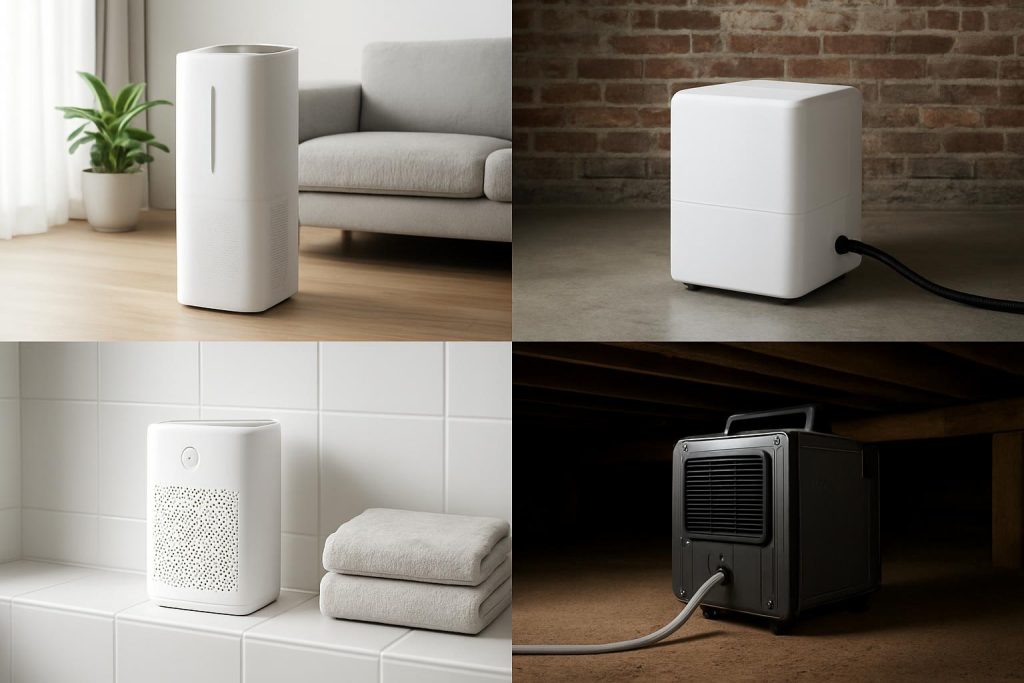
For most homes, start with Frigidaire 50 Pint in living areas. If you want fewer tank trips and a pump for basement routing, Midea Cube 50 Pint wins. For small bathrooms and closets, Pro Breeze Mini is the simple choice. For crawl spaces or garages, ALORAIR Sentinel HD55 is the durable solution.
Buying guide for 2026
Capacity and ratings made simple
Modern pint ratings follow DOE 2019 testing, which better reflects real homes. A 50 pint unit under this standard is the new baseline for medium and large rooms. If your space is damp and larger or below grade, a 50 pint class is the default starting point. Go smaller only for truly small rooms.
Match room size and moisture level
Bedrooms, living rooms, and open plan spaces usually do well with one 50 pint unit placed centrally. Small bathrooms and closets do best with a compact Peltier unit. Crawl spaces need a dedicated, continuous drain dehumidifier that handles cooler air and runs out of sight.
Set the right target
Aim for 45 to 50 percent relative humidity in most homes. In basements, staying near 50 keeps materials stable while avoiding over drying. If the room feels chilly, do not chase a very low number. Stable comfort beats extremes.
Drainage choices
Bucket only is fine if you are home to empty it. Gravity drain turns a standard unit into a low maintenance appliance if you have a nearby floor drain. A built-in pump helps when the hose must rise to a sink or window or travel a longer path. Choose the simplest system that works with your room layout. Fewer parts means fewer points of failure.
Noise and placement
Fan noise matters in bedrooms and living rooms. Frigidaire keeps tone even and is workable for shared spaces. In basements, you can accept more fan whoosh to move air faster. Leave a few inches around the unit so air flows freely and do not block the back or sides.
Energy use and low temperature performance
Energy Star models save on long runs. In cool areas, look for automatic defrost and operating ranges that suit your climate. Crawl space units are built to run cold and cycle defrost without babysitting.
Controls and smart features
On unit controls are enough if you are nearby. Apps help in basements or vacation homes by sending alerts and allowing quick target changes. I think smart features are useful only if they simplify your routine.
Maintenance and hygiene
Clean the filter and empty or rinse the tank weekly during heavy use. Disinfect the tank and reservoir monthly with a mild cleaner. Check the drain hose for kinks or algae growth and flush as needed. Wipe the intake grille to keep airflow strong. Consistent cleaning prevents odors and keeps performance steady.
Power outages and restarts
Auto restart brings the unit back with your last setting after a power blip. This matters if you run it unattended or if storms are common.
Budget and total value
Do not buy too small. A right sized unit running at a moderate speed is quieter, lasts longer, and uses less energy than an undersized unit grinding at max. Spend for a pump only if your layout needs it.
Setup checklist for fast results
Close windows and exterior doors. Place the unit where air can move around it. Set target at 45 to 50 percent. If using a hose, ensure a steady downward slope or prime the pump per the manual. After two hours, recheck humidity and fine tune. In the first week, confirm that the bucket or hose drains correctly and that no water is pooling around fittings.
Common mistakes to avoid
Do not run with windows open. Do not block airflow with curtains or furniture. Do not set humidity far below 40 percent for long periods. Do not ignore filter and tank cleaning. Do not run a standard room unit in a crawl space and expect long life.
My quick take
Frigidaire 50 Pint fits most homes and runs quietly and predictably. Midea Cube 50 Pint with Pump is the easiest basement solution and cuts daily chores. Pro Breeze Mini makes small damp rooms livable with minimal fuss. ALORAIR Sentinel HD55 handles crawl spaces and garages where consumer units fail. Pick the one that fits your space, set 45 to 50 percent, and automate drainage. That is the fastest path to clean, dry, and comfortable.
Conclusion
A good dehumidifier is a simple appliance with an outsized impact on comfort, cleanliness, and building health. Choose capacity by room size, plan drainage before you buy, and keep maintenance routine. With these four picks and the setup steps above, most homes can reach stable humidity in a day and keep it there with little effort.
FAQ
Q: What humidity level should I set for most homes?
A: Aim for 45 to 50 percent relative humidity in most homes, and near 50 percent in basements.
Q: Do I need a dehumidifier with a built in pump?
A: Choose a pump if you must drain uphill or over a long path to a sink or window, otherwise a gravity drain to a nearby floor drain is simpler.
Q: Which dehumidifier is best for a crawl space or garage?
A: ALORAIR Sentinel HD55 is the durable solution for crawl spaces, garages, and unfinished basements.
Q: What is the best all around pick for living areas and bedrooms?
A: Frigidaire 50 Pint with WiFi is the balanced pick for most homes and shared spaces.
Q: How do I maintain a dehumidifier for steady performance?
A: Clean the filter and rinse the tank weekly during heavy use, disinfect the reservoir monthly, and check the drain hose for kinks or buildup.